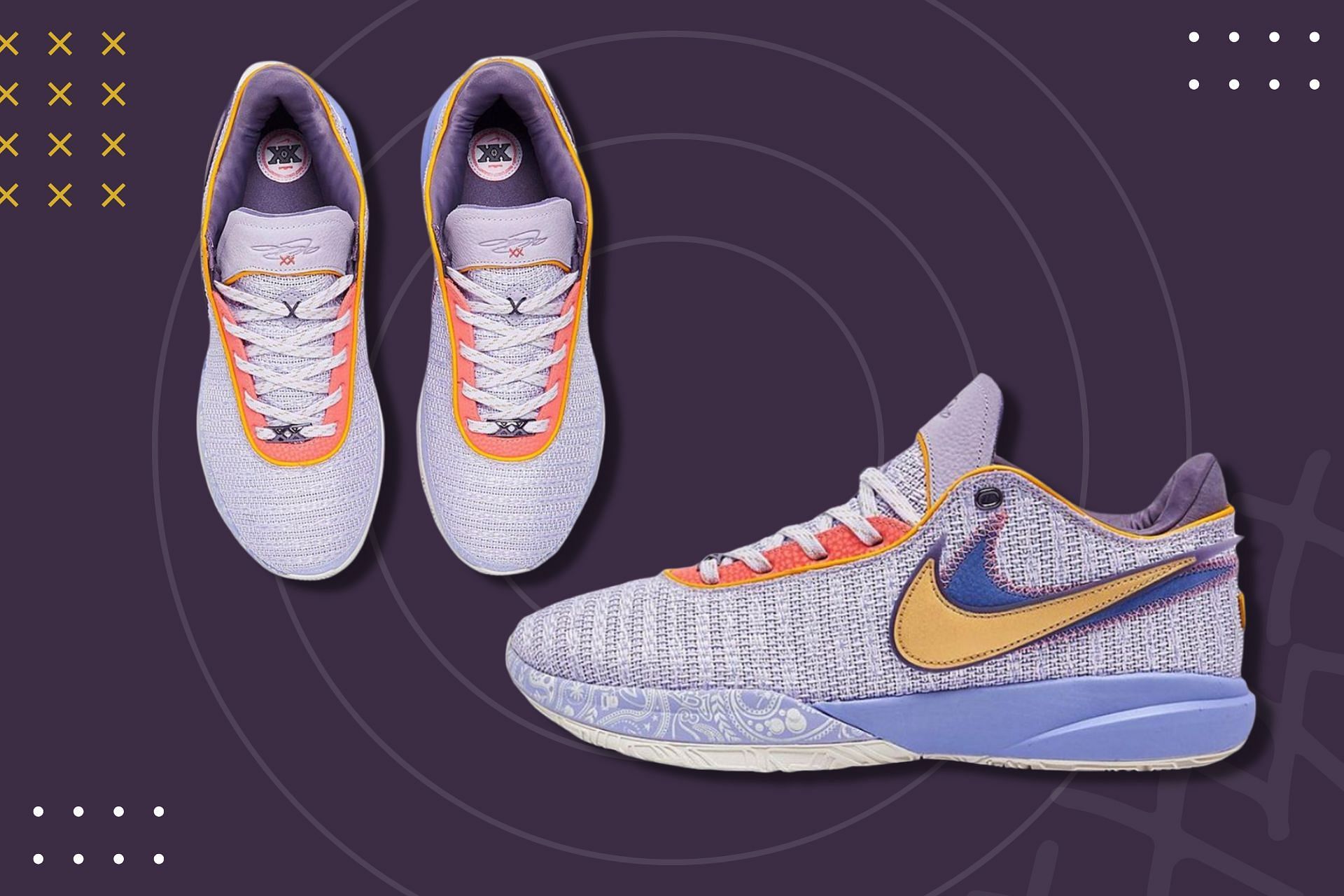
The Nike LeBron 20 is one of the most highly anticipated LeBron shoes in recent memory, mostly thanks to its resemblance to the Nike Kobe line.
Release Date: September 2022
Price: $200
9/10
Total Score
LeBron James is entering his 20th NBA season and his third with the Los Angeles Lakers. Over the off-season, his sons, Bronny and Bryce, have been in the headlines more than King James due to their development and exposure. They actually debuted the Nike LeBron 20 on the court before their father did. Right off the bat, people loved the design, and that love grew deeper when the tech specs were revealed.
Traction
Duke4005: The Nike LeBron 20 has the best traction I’ve played in for years. I’m talking Air Jordan 37, Nike Kobe 9, Flow – you name it, the Lebron 20 will match and probably beat it. On a day when I watched players in Nike KD 14, Nike Kyrie 5 Low, and adidas Dame 7 slip and literally fall on the terrible 24 Hour Fitness court, the Nike LeBron 20 was sticking like crazy and never skated or dropped. Outside? I wouldn’t – the traction is soft, and the “grooves” are thin. On a rough outdoor court, I can see these lasting about as long as Russell Westbrook and Pat Bev get along.
Stanley Tse: The Nike LeBron 20 has hands down the top 5 best traction of all the LeBron models ever created. Hear me out, I’ve tested all the models including the Soldiers and Ambassadors as well as Witness models, and the LeBron 20 is definitely a hard one to beat. On indoor courts, I stuck to the ground. I occasionally had to wipe only on super dirty surfaces, but after a quick wipe, I was up and at it. I would stay away from outdoor courts as the traction will wear down heavily (well, unless you have an extra $200 lying around).
Cushion
Duke4005: We all know LeBron is a beast on the court – size and speed still like no other at age 37. Nike has constantly been giving his retail shoes HUGE air bubbles and Zoom bags and overall volume coverage – and he hasn’t been wearing them. Last year we saw him in the Ambassador and his retros more than the LeBron 19, and there’s a reason – the cushioning. Even with Nike giving him pairs with waaaaaay smaller bubbles, he went with Zoom. The Nike LeBron 20 comes through with a forefoot Zoom Turbo unit that is top-loaded (pretty much right under your forefoot) and a HUGE 13-millimeter heel Zoom unit, all inside a Cushlon midsole. This isn’t Cadillac cruising – this is Jaguar smooth and speed. Bounce, impact protection, decent court feel, heel like a pillow (don’t land on it to try) – the Nike Lebron 20 is a shoe that made me feel faster while keeping my knees and back happy. The Nike Kyrie 8 was my favorite cushioning setup from Nike last year, and the LeBron 20 takes what worked there and amplifies it by 10.
Stanley Tse: Bottom-loaded large 13.5mm heel zoom, top-loaded forefoot Zoom Turbo, and full-length cushlon midsole. OMG, this is the McLaren of sneaker cushioning. It’s fit for a King (James). The shoe doesn’t feel too high like the LeBron 19 did. The LeBron 20 provided a nice balance while staying lower to the ground with proper court feel, but most importantly provided enough bounce-back after rebounds or jumps and even running down the court. While I’m a slightly bigger player, the break-in time for me only required a warm-up and probably one game. Once the cushlon broke in and contoured to my feet, it was game on. Not only does it work extremely well for myself and my old knee(s), but it definitely kept my legs fresh from end to end on back-to-back games with the stellar impact protection.
Materials
Duke4005: It says Flyknit, but it’s not like the Flyknit of the past. I said it feels like an old washrag or your grandma’s couch – it feels worn in and soft in some spots and rough in others and has no give laterally thanks to the “wire” (fishing line) running through the knit from side to side over the foot. It doesn’t affect flex while keeping the foot locked in – well done, Swoosh. The tongue is a sleeve and has a nice patch of leather at the top while the sleeve uses Nike Sphere in the heel (a callback to the Zoom Generation, LeBron’s first shoe). Sphere is a nylon fabric on top of the foam with holes cut in the foam to keep the skin spaced from the fabric, leading to better ventilation and cooling from the increased airflow. We also get a carbon fiber plate in the midsole that does NOT get in the way of playability, sitting on the sideline until needed.
Stanley Tse: The strategically weaved upper gave the Nike LeBron 20 a nice “look,” and it does seem all too familiar (i.E. Kobe XI elite upper). This is not necessarily a bad thing as the weave and wire strands help reduce the weight of the shoe while giving it structural stability. In addition, adding back the comfy Nike Sphere heel – a call back to the Nike Air Zoom Generation – as well as a carbon fiber plate, Cushlon midsole, forefoot, and heel zoom, I mean, this is the way the future of Nike Basketball should be built.
Fit
Duke4005: I am a 10.5 in Jordan Retros and a 10 in adidas basketball shoes. The Nike LeBron 20 I ordered was an 11 based on the Air Jordan 36 and Kyrie 8. The LeBron 20 fit length-wise like those two shoes. I could have possibly gone with a 10.5 (I have a pair coming in) but I like the extra room in the toe box. The heel slip is nada and the lacing and knit upper let the shoe wrap the forefoot through the midfoot perfectly.
Stanley Tse: I’ve always had a questionable relationship with LeBrons and the fit. However, it’s safe to say, with my slightly wide/flat feet, that the Nike LeBron 20 fits absolutely true to size. I have a little bit of room in the toe box just the way I like it, and I felt locked in as soon as I laced up. No lace pressure, no heel slippage, nothing. Just a beautifully crafted, well-fitting performance shoe.
Support
Duke4005: Well, it’s built for Lebron, so it has serious support, but nothing restricting or boot-like like the LeBron 17 or LeBron 19. Your basic elements are the carbon plate in the midfoot and a very slight outrigger to keep your foot upright. The base of the shoe is wide, and the heel is fairly solid so underfoot while playing feels like a “guard” shoe. As I have gotten older support/stability has been needed, and the Nike LeBron 20 never left me scared.
Stanley Tse: The shoe is supposed to fit for a King, and by a King, I mean me, HA…..(crickets). The low-top build provided no restriction and allowed me to play freely knowing I was locked in by not only the fit but also the comfort of the cushioning. In addition, since I push off heavily via my forefoot, the nice wider base really helps my feet plant and push off for my quick (super-lagged) first step. Honestly, no surprises, except I didn’t need to ice my knees/legs after the game (wahoo!)
Nike LeBron 20 Overall
Duke4005: Is the Nike LeBron 20 the best Nike basketball shoe this year? Possibly. Probably. And for $200 it had better be. Fast, stable, cushioned, court feel, looks – wow. The only thing holding it back is the price tag ($200 is not easy, especially in 2022’s economy), but if you are a player who wants the best, do not hesitate to grab it. Run fast, jump high, fill the lanes, find your teammates, pretend your LeBron – it’s easier in this model than you would think.
Stanley Tse: Ok, you ready for this? The is by far, the best performance LeBron model to date and absolutely (and I know I’m being premature with this), a top 5 performance shoe this year. One gripe? The price. 200 beans.
I love the packaging/pull-out box like they did back in the day via the LeBron 2, and the included product card. But $200 is heavy. I’d like to see the model be around $165-$180. This doesn’t mean the shoe is bad, the shoe is OUTSTANDING. If you want all the nooks and crannies, never having to second guess your jumps/movements/planting, and want to feel like having a high-end luxury sportscar on your feet, the Nike LeBron 20 is it. The bar is set quite high now…so it will be fun to see what Nike does with the LeBron 21.
2022 has delivered some stylish, chunktastic running shoes with New Balance right in the middle of the fray. This summer we reviewed the ultra bouncy and massively cushioned New Balance FuelCell SuperComp Trainer, and we loved it. So, when the New Balance Fresh Foam X More v4 landed at our door, we were ready for more chunky running and cautiously optimistic about its performance.
Last year’s Fresh Foam X More v3 made our Best New Balance Running Shoes and Best Running Shoes for Wide Feet lists because it was a beefy, cushioned runner that delivered comfort across miles and miles of easy running. Can the New Balance Fresh Foam X More v4 deliver more of the same?
New Balance Fresh Foam X More v4
Release Date: September 2022
Price: $150
Weight: M 10.4oz, W 8.4oz
Drop: 4mm (30mm forefoot, 34mm heel)
Sizing: True to Size
Rundown: The New Balance Fresh Foam X More v4 is a stylish, affordable shoe with great cushioning alongside industry-leading stability and fit.
Pros
Fresh Foam X
Accommodating Fit
Stability
Style
Price
Cons
Outsole Durability
Bulk
Pros
Fresh Foam X
Drew: New Balance’s top-of-the-line foam is FuelCell. Fresh Foam X is its less expensive brother meant for everyday use. If you’re not familiar with it, think Kyrie 9 or Jordan Luka 1 as the closest comparison. On the New Balance Fresh Foam X More v4, the Fresh Foam X is a big stack of overly plush EVA that feels great on foot for any number of miles and/or chores. I really enjoyed the Fresh Foam X on foot during all my runs and even took it 10 miles down a Denver-area greenway without any issues. It’s probably a bit much shoe for long runs, but the cushion could easily handle runs of 12+ miles without deadening.
In addition to runs, the Fresh Foam X More v4 became one of my go-to household chore shoes and my airport shoe. Got a super long walk to your connecting gate? No problem, you’re covered. These could easily pass the theme park test. They can stay on all day through lots of standing and walking and never get uncomfortable, which is why they’re so great as airport shoes. Well, that, and they’ve got plenty of room for your feet to expand in-flight…
Tyler: Admittedly, I’ve stayed away from any NB models that sported Fresh Foam since early 2020 as I had a consistent experience with hot spots underfoot, no matter the distance or pace. All I could attribute it to was the Fresh Foam. So to say I was apprehensive when these came through our doors would be an understatement. Well, whatever was tweaked in the New Balance kitchen made this recipe agree with my feet and get me back on the Fresh Foam train. Fresh Foam X is an excellent combination of plush and smooth. And while I knew this was a high-cushion runner, it still surprised me with how soft, yet stable, the midsole was. Similar to Drew, these have started to rival the Hoka Ora Luxe as my around-the-house and errand-running shoe.
Accommodating Fit
Drew: Before I first tied the laces, my normal-ish foot felt like it was swimming in the New Balance Fresh Foam X More v4. The upper is very roomy. But New Balance did a great job with the geometry of the upper because lacing up I was able to get a very comfortable fit and lockdown where my foot didn’t move around despite the extra room. This is really valuable in a running shoe because your feet expand the more you run. It’s also really valuable on an airplane, so you don’t have to be one of those…people (I’m being nice here) that need to remove their shoes as soon as the plane hits altitude. Regardless, it’s nice to know you have a shoe in your closet that is never going to make your foot feel like an overstuffed sausage. It’s an extremely valuable shoe for the day after a hard workout or long, long run when your feet need some sweet relief.
While I think a fair amount of wide footers could fit the normal New Balance Fresh Foam X More v4, there’s an even more accommodating version available. Both Running Warehouse and New Balance offer a wide version in both men’s and women’s (links below). The fit of the regular version plus the wide options may make this the most accommodating running shoe on the planet.
Tyler: I’m reading Drew’s comments as I write this and we had the exact same experience upon initial try-on. While I’d much rather put on a thicker pair of socks before sizing down, my first slip-in left me questioning if the shoe was too big, but upon standing up, the fit was dialed in. I felt a touch of support on the lateral side of each shoe and am happy to say that sensation continues, even after a lot of miles. Bonus points for New Balance shoe laces. I’ve said it before, and I’ll say it again: New Balance has the best shoelaces of any brand on the market. From the length to the stretch, to the thickness, a perfect lace can make a good shoe feel great.
Stability
Drew: Sometimes, when an upper has lots of room, and the midsole is big and chunky, it’s a recipe for instability as your foot moves around within the upper and threatens to slide off the footbed. Not so here. The upper lockdown is solid, especially in the heel and midfoot. In addition, your foot sits inside the midsole walls at the heel and midfoot. The midfoot walls go super high, reminding me more of a 90s basketball shoe than a modern running shoe. Your foot is staying on top of the midsole.
And the midsole itself flares out in all directions to create natural outriggers that keep the shoe upright on uneven pavement or sharp turns. There’s also a large channel down the middle of the outsole that allows the four corners of the outsole to work independently and provide extra stability with the added benefit of letting your foot feel more flexible. It’s a great setup with a bunch of little things done to improve the sturdiness of the shoe and keep the wearer upright no matter what the road throws at them.
Tyler: Stability wasn’t something I thought about when wearing the shoe, but sitting here writing this review, I think the stability of the shoe is what makes it ride so nicely. Now, it’s not a stability shoe, but it does a great job of providing the all-around support that ensures you have a consistent and solid underfoot experience.
Style
Drew: I’m no fashion guru, but even I notice when people comment on my shoes this much. The number of people that complimented the New Balance Fresh Foam X More v4 while I had them on foot was surprising. I think New Balance nailed the bulbous “Dad shoe with a modern flair” look that’s popular right now.
Tyler: I drive a Prius with two car seats in the back. This shoe is perfect for me. End of story.
Price
Drew: Last year’s version (the v3) was $160. This year’s version is better and costs $150! I can’t think of this ever happening before in the shoe industry, and I’ve been reviewing shoes for 12+ years. Given today’s inflationary environment, this is one of those pricing quirks that you should take advantage of before New Balance closes the loophole.
Tyler: It’s unreal to think that in this climate, New Balance decreased the cost of such a plush trainer, but I’m not mad about it. To keep from jinxing myself, I won’t say what I would pay for this shoe, but spoiler alert: it’s more than $150.
Cons
Outsole Durability
Drew: I really love the outsole’s design, and the many flex grooves that make it feel more malleable than a shoe with this chunky of a midsole should be able to feel. But I’m tearing through the outsole at a pretty good clip. I’ve worn away a lot of the rubber in my toe-off zone during my 75ish miles in the New Balance Fresh Foam X More v4. The rubber is thick, and there’s more to burn…but people who are heavy landers may burn the rubber down to the foam quicker than 300 miles.
Now, even if you do burn away all the rubber up front, there’s still plenty of foam underneath, so I don’t expect the Fresh Foam X More v4 to be unusable. But, we’re going into winter so be careful about burning away all that rubber and then going into snowy runs with a bald forefoot. That would be a recipe for disaster.
Oh, and all I said above just goes for the forefoot. My heel and midfoot strike zones look great. I think the rubber used at the heel and midfoot, in addition to being a different color, is made of a more durable rubber compound. So, if you’re a heel striker, I think you’ll get normal durability from the outsole.
Bulk
Tyler: I debated even including this as a con, but wanted to be objective in the review. This is a bulky shoe, straight up. I found the bulk of the midsole to come into play on a few extremely hot days when I was wrapping up a long run. As my form got sloppier, I could sense that the shoes were flailing a bit under me and I was ready to get them off. I’d chalk that up in part to bad conditioning and in part to the shoe. It’s not a game changer in the least but something to consider.
New Balance Fresh Foam X More v4 Summary
Drew: The New Balance Fresh Foam X More v4 is a stylish shoe with great cushioning and industry-leading stability and fit. This is likely going to be a popular shoe among runners, walkers, and people who want a comfortable running shoe for everyday tasks. I heartily recommend picking it up and enjoying all the miles you’ll put in it along with a visit to a theme park or an airplane ride or two.
Tyler: For me, this is a top-3 shoe of 2022. It’s exactly the type of shoe that I gravitate toward, and I’m so happy that the Fresh Foam X didn’t give me the hot-spot sensation of past years’ Fresh Foam. It’s a very comfortable, affordable, and excellently executed high-mileage shoe that sports a ton of versatility.
A little late to the super shoe game, Under Armour is finally releasing its own marathon racing shoe, the UA Flow Velociti Elite. Partially modeled after Under Armour’s daily trainer, the UA Flow Velociti Wind 2, it also introduces a new Under Armour foam for the majority of the cushioning.
Once I got it in hand, the UA Flow Velociti Elite both looked and felt the part of a legit marathon racing shoe. But the real test was getting it on foot and going fast. I really enjoyed the experience. Here’s why:
UA Flow Velociti Elite
Release Date: June 2022 (limited), Spring 2023 (Global)
Price: $250
Weight: 7.5oz
Drop: 8mm
Sizing: True to Size
Rundown: The UA Flow Velociti Elite is a bouncy marathon shoe that’s surprisingly stable and fun to use for most road racing distances.
Pros
Pebax & Flow
Traction
WARP 2.0 Upper
Stability
Cons
Tongue (edges)
Outsole Durability
Pros
Pebax & Flow
Under Armour’s Flow, a foam that’s great at blunting the impact of forceful ground strikes is used as the bottom layer (and outsole) of this cushioning combo. It appears to be a softer version of the Flow originally used on the Jordan 37 and the UA Flow Velociti Wind.
But the real hero, so to speak, is the thick slab of pelletized Pebax foam that sits above the Flow. Pebax now appears on almost every marathon racing shoe of consequence. Why? Because it’s both extremely light and super springy. Since Nike showed the world Pebax’s capabilities with the Vaporfly Next%, runners have sought it out in droves.
Is Pebax worthy of the hype? Yes. Just look at our list of Best Marathon Racing Shoes. Under Armour adding Pebax to its arsenal is a signal that they’re serious about high-end running shoes.
The Pebax and Flow are separated by a full-length carbon plate, which while not an Under Armour first, is well used here. Together, the two foams and the plate deliver a snappiness. Dig your foot into the ground, and it pushes back with equal force. And it all happens without feeling too stiff or clunky. It’s just a smooth ride from landing toe-off. It feels similar to, but also an improvement on the midsole of the original Saucony Endorphin Pro.
Traction
The Flow outsole again delivers better than expected traction. As you can tell from my photos, I got these out in some vicious southern rainstorms and experienced zero slippage. Every time I test a shoe with a Flow outsole, I expect slippage as it’s just foam gripping the ground. But each time I can take turns at breakneck speeds and don’t have to worry about my footing. A shoe that grips like the UA Flow Velociti Elite is a great option when conditions are tough.
WARP 2.0 Upper
WARP is a knit, nylon, and mesh upper pattern with both vertical and horizontal lines providing containment and lockdown. As I’ve stated in my previous Velociti Wind reviews, WARP is comfy and supportive while also extremely breathable and flexible. It’s Under Amour’s best running shoe upper, so it makes sense that it would appear on Under Armour’s best and most expensive running shoe.
The WARP 2.0 upper is slightly tweaked from previous models including fewer layers to get even lighter and more breathable. The changes are perfect for a race day shoe. This upper stacks up very well with other marathon racing competitors.
Stability
Despite what is a narrow-ish race day build, the Jordan Luka 1 is a super stable shoe. The combo of the Flow layer of cushion cresting into a triangular heel counter type piece, the actual traditional hidden heel counter, and the lockdown of the WARP upper all work in tandem to keep the foot on the footbed. Marathon racing shoes often leave you sliding off the footbed or feeling tipsy around high-angled turns. But that doesn’t happen at all in the Velociti Elite.
Because of this stability, I can see the Velociti Elite translating well as a 5k racing shoe. You get a great bounce from the midsole while never feeling insecure navigating tricky corners.
Cons
Tongue (edges)
I don’t love synthetic suede tongues because synthetic suede is kinda gross when super sweaty. Performance-wise they work fine though. And the tongue on the UA Flow Velociti Elite is ok, except for the edges.
Below the collar of the shoe, the edges of the tongue fold over underneath the tongue every time you slip your foot into the shoe. Trying to fix them lasts seconds before they just flip right back. It’s super annoying and leaves the tongue feeling a little thicker towards the bottom edges. It didn’t result in any hotspots for me, but it did tick me off and make me consider potential solutions like cutting the edges off (though I’m not sure that would completely solve the problem). I talked to others that tried the shoe, and it happened to them as well. It’s not a huge issue, more a minor annoyance…but one that shouldn’t happen on a brand’s flagship marathon racing shoe.
Outsole Durability
We’ve seen this particular con pop up on a lot of marathon racing shoes, and most of those have some rubber on the bottom. Flow is surprisingly durable for a foam outsole and lasts longer than most other foam outsoles (I’m looking at you Hoka).
But, when you pay $250 for a marathon racing shoe, the foam fraying after 40-50 miles is disconcerting. Will the shoe last 250-300 miles? Yes. I’m just worried that by mile 200, some wearers may not get the same reliable traction due to excess wear. Not a deal breaker, but if you’re tough on outsoles, it’s something to consider as you choose your marathon racing shoe.
UA Flow Velociti Elite Summary
The UA Flow Velociti Elite packs the best midsole cushion combo in Under Armour’s short history of running shoes. It’s bouncy and protective. It’s not quite as good as the best marathon racing shoes out right now, but it’s still a viable racing option if you enjoy the shoe’s fit and feel.
The Velociti Elite grips well in all conditions, has a fantastic upper, and is way more stable than expected. It’s got a couple of small issues but nothing that’s a deal breaker. All in all, the UA Flow Velociti Elite is a super fun shoe that shows off some distinctive Under Armour DNA. It also makes me hope Under Armour keeps making high-end marathon racing shoes because they bring a different perspective to the running shoe industry.
Rundown: The Under Armour HOVR Rise 4 is one of the best cross-training shoes available thanks to its versatility and function.
Release Date: 2022
Price: $110
Weight: 11.1 oz (size 10)
Drop: 8mm
Fit Guide: True to size
9/10
Total Score
Pros
TriBase Technology
Lacing System
Outsole Traction
Cons
No Traditional Tongue
Lack of Arch Support
The Under Armour HOVR Rise 4 features two technologies for which Under Armour is well known: HOVR cushioning and TriBase stability. The combination sounds like a recipe for a comfortable yet stable shoe, and it usually is. Plenty of previous Under Armour training models including various Project Rock models have used the combination.
Does the HOVR Rise 4 deliver performance in line with its tech specs? Fortunately, we’ve got a positive answer for you. The Rise 4 is a fantastic performance model that will handle all your training needs.
Pros
TriBase Technology
TriBase is a triangle on the outsole that aims to make the back half of the shoe rigid and stable for lifts. It does precisely that in my experience with the Under Armour HOVR Rise 4. In some shoes like the adidas Dropset Trainer, I feel a rocking motion on exercises like dumbbell bent over rows or goblet squats. However, the TriBase outsole geometry made it so I never felt unstable and forced forward. From my midfoot to the heel, my foot stayed down and flat.
Lacing System
After my horrendous experience with the Nike SuperRep Go 3 Next Nature, I was glad to test a shoe with an excellent lockdown lacing system. Most of the lace holes are nylon cables running down to the footbed, so the materials suck you in and ensure you’re contained. The top eyelets are connected to the heel wings, reminding me of the Air Jordan 4. The top eyelets and the wings do a great job of preventing heel slip. Just make sure you wear thick socks, so you don’t compromise the fit.
Outsole Traction
The traction on the Under Armour HOVR Rise 4 is made up of nubs shaped like circles. Everywhere I brought them, they did well. I tried doing dribbling drills on concrete, and they not only gripped well, but they also didn’t show any signs of wear. Whether on typical exercise mats, hard concrete floors, or nicer wood floors, this outsole will ensure you won’t slip.
Cons
No Traditional Tongue
This is more of a preference than anything, but I know plenty of people prefer a traditional tongue. These have a one-piece booty construction that has a sock-like feel to them. The good thing is that it will conform to your feet the more you wear them. The bad news is that you can’t adjust each section as well as you could with a traditional tongue setup, and it’s harder to get in the shoe. I had to pull both sides at the start to ensure I didn’t crush my heel while trying to get my foot inside the Rise 4.
Lack of Arch Support
There are no sidewalls like the adidas Dropset Trainer and Nike Freak 4. While that feature is mainly for lateral stability, which these do a decent job at, it also doubles as arch support, especially for flat-footers like myself. I couldn’t get away without using an orthotic in these. If you have a normal arch, though, you should be okay. Luckily, Move Insoles are compatible with the Under Armour HOVR Rise 4 if you need extra arch support.
Under Armour HOVR Rise 4 Summary
The Under Armour HOVR Rise 4 is a cross-training shoe that stays true to the category. It has enough cushion to handle HIIT and jump training. It has enough stability to do heavy deadlifts, squats, and other compound lifts. It has enough outsole durability and grip that you can be confident bringing these to the gym, on vacation, or keeping them at home. Whether you’re just starting to exercise or have been in the game for some time, you’ll find the Under Armour HOVR Rise 4 features plenty to be happy about.
The Nike Cosmic Unity 2 was a letdown, and it’s just not safe to recommend this shoe to any basketball player.
Colorway: Coconut Milk/Atmosphere/Mint Foam/Black
Release Date: 2022
Price: $160
6.5/10
Total Score
The Nike Cosmic Unity was a famous basketball shoe when it was released. It provided a low-to-the-ground ride while still having the springy feeling of Zoom Air courtesy of the Strobel unit. The Nike Cosmic Unity 2 looks to build on that repertoire by keeping the same cushion setup but with a different upper and aesthetic design. Does this year’s follow-up match the standard set by the original? In a word? No.
Traction
Traction is the Nike Cosmic Unity 2’s best feature. The pattern is multidirectional, keeping you covered on every movement. If you’re into a squeaky traction pattern, you’ll find it here.
Better yet, the rubber compound used is effective and durable indoors and outdoors. It’s as good of a traction setup as you’ll find on the market today.
Cushion
The Nike Cosmic Unity 2’s cushion is its other standout feature. Just like the original model, these feature a full-length Zoom strobel unit, which provides a ton of responsive cushion while retaining a ton of court feel.
The foam compound used here is softer and less bulky than what was used on the first Freak 4 but it’s not plush like a React or Cushlon setup. The star of the show is the Zoom, and the foam is a great supporting act. The shoe is also crazy flexible in the forefoot, so the spring-like effect of the Zoom is felt even more than it would be otherwise.
It’s a real shame I didn’t like the rest of the shoe because this is about as good of a combination of traction and cushion as it gets.
Materials
This is where things start to go downhill.
The Nike Cosmic Unity 2 features a thin textile upper with some fuse overlays in the lateral and medial forefoot areas. In the back of the shoe, the collar uses a felt-like material, with a lot of foam rising from the midsole to help with containment.
My main issue was with the textile base – it doesn’t provide any kind of structure or support. This wouldn’t have been as big of an issue if I had been able to get a better fit (spoiler alert: it didn’t happen) or if the midsole would have cradled my foot in the forefoot a little bit more like the original Cosmic Unity did.
The bottom line is the materials are cheap and not very strong. The fact that this shoe costs $160 makes the material choices even more egregious.
Fit
I went true to size, and length-wise, it was just right. As for the width? Yikes.
The shoe is outrageously narrow in the midfoot area. The sections of midsole foam that wrap up onto the upper make things pretty cramped, but the dealbreaker, for me at least, is the shank plate, which I could feel pinching the sides of my feet with every step. If I loosened up the laces to relieve that pain, the fit in the heel was compromised. I’d say the forefoot fit would also be compromised, but I never got a secure fit in the forefoot to begin with. On lateral movements, my foot regularly shifted within the forefoot area of the shoe.
My foot is pretty narrow, so the fact that this shoe was still too narrow for me in the midfoot is cause for concern. It’s important to remember this is just my experience. If you’re able to try the shoe on and can secure a good fit, then I’m not only very happy for you but also more than slightly jealous.
The inconsistent fit I experienced meant I was never confident in my movements on the court, and it also made for, uh, less-than-stellar support.
Support
Fit is the most important aspect of a shoe’s support, so the Nike Cosmic Unity 2 is already off to a bad start. When your foot isn’t locked into a shoe, the injury bug is much more likely to bite.
While the Cosmic Unity 2 has all the standard features that would aid a supportive shoe – a midfoot shank, heel counter, a midsole that wraps up onto the upper, and a wide-ish base, it’s still not enough to make up for the lackluster fit and materials.
I badly rolled my ankle on a routine play while wearing the Cosmic Unity 2, and while I won’t blame the shoe for the injury, I’m fairly confident I wouldn’t have suffered the injury in most other shoes – especially the original Cosmic Unity.
The Cosmic Unity 2 is simply too flexible, too unstable, and has too sloppy of a fit for me to consider them anything close to “supportive.” Wear at your own risk.
Overall
I had high hopes for the Nike Cosmic Unity 2, and while the standout features, traction, and cushion, lived up to my expectations and more, there were too many issues stemming from the fit and materials for me ever to want to take this shoe on-court again.
If you can find a fit that works for you, that could be enough to make up for the shoe’s overall lack of support, and you may end up enjoying these. The ultra-narrow and painful midfoot area make me think you’re better off taking your $160 elsewhere.
Looking for a fast, nimble sneaker that’ll hold anywhere you’ll take it? Kyrie Irving’s budget signature line from Nikey has some very solid offerings under $100 but what about the 5th iteration that seemed to receive mixed reception? Let’s analyze it in this comprehensive Kyrie Flytrap 5 review.
After a good 2 months of indoor & outdoor hoops, I have broken down the shoe’s fit & comfort aspects, performance, build quality & value for the price, versatility, and decided if it’s finally a shoe made for everyone or just another niche-focused model from Uncle Drew.
SHOW TABLE OF CONTENTS
SPEC SHEET
2-MIN REVIEW
In a hurry? Here’s the quick Kyrie Flytrap 5 review
The Nike Kyrie Flytrap 5 is another traditional release in Uncle Drew’s budget signature sneaker line. It’s a niche shoe, meaning not everyone will enjoy this one.
You’ll get great outdoor-ready traction but be sure to keep wiping the outsoles down to avoid dust buildup. The EVA midsole + a forefoot Zoom unit won’t give you any bounce or great step comfort. The soles of my feet were hurting after a longer outdoor session.
If speed, precision, and staying low to the ground are keys to your game though – you’re going to love this setup. Support wasn’t terrible even despite my physical playstyle but I wouldn’t prefer this setup over something more balanced. A hard sell for an explosive wing or a shifty player.
This cheap mesh build is quick to break in but due to the roomy toebox, I wouldn’t recommend these for a narrow footer. Overall, a decent $90 performer that could be an indoor/outdoor beater for someone who can’t afford to go past $100.
I. FIT & COMFORT
True to size or should you adjust? How does the shoe fit? What about overall comfort?
SIZING GUIDE
Let’s begin with the need-to-know. The Kyrie Flytrap 5 definitely fits true to size in a snug manner. I barely had any space for my toes length-wise but not to the point where I couldn’t move my toes at all.
Width-wise, more of the same. A fairly narrow construction that eases up a bit in the toebox but my wide foot did feel fairly suffocated, especially initially.
The main pressure points for a wide foot would be the lateral side of the toebox (around the first eyelet) and the middle region at the top of the lacing system.
However, I have experienced much worse. These are playable for anyone who’s not a crazy wide footer (whatever that means but you get the idea). Though expect some pressure as this toebox is not among the roomiest.
Mind you, this is the standard US version and not the widened EP variant.
So, I recommend going true to size for pretty much anyone except very prominent wide-footers or people who simply can’t stand a one-to-one fit. Those hoopers should try a half-size-up or the EP option.
Besides some pressure in a few areas, I don’t have anything bad to say about the fit. No heel slippage or any kind of foot movement inside the footbed, no pinching, ankle digging, or anything nasty. I’ll give it a pass.
COMFORT
Comfort-wise, you’ve probably already expected that the Flytrap series won’t give you anything special for the price you’re paying.
Basic materials, basic internal construction, basic build quality. Basic doesn’t mean bad but if you’re anticipating a luxury time for your feet – this is not the direction to go.
I found very minimal padding along the ankle and throughout the shoe overall, though not to a point where I’d feel bothered. Who knows, perhaps more than a couple of months will introduce some digging but not the case currently.
The shoe utilizes a half-bootie construction, so the tongue is sewed directly to the upper and allows for greater lockdown.
However, this type of setup combined with a compact forefoot means that putting the shoe on is a damn hassle. Especially for my thick feet.
There were times when I had to repeatedly smash the floor with half of the shoe on just to stuff the heel inside. It’s annoying but the experience once my foot’s inside is ultra-secure. A trade-off I’ll live with.
Besides that, all else was okay. These are feathery light and feel very quick to play in, and the snug fit allows me to forget everything besides the hoop session (besides the occasional pressure due to the narrow toebox).
II. TRACTION
How does the shoe grip a variety of surfaces? What about sensitivity to dust? Will it handle outdoor environments?
The Nike Kyrie Flytrap 5 features a computer-generated traction pattern and solid rubber outsoles for all available colorways.
Taken straight from the Kyrie Flytrap 4 and the Kyrie 8– the end result is about what I expected.
PERFORMANCE
I had somewhat of an untraditional testing phase with these. I played indoors more than outdoors this time, and it’s usually the other way around.
Indoors, I primarily hooped on a soft rubberized surface and I also managed to squeeze in a few sessions on classic hardwood.
The traction on both floors was fine. It’s probably the best way to put it. Not top-10 of all time, not exceptionally aggressive, but not terrible either.
I didn’t have issues with coverage on pretty much any movement I threw at them. Mostly.
The slight hiccups appeared when I wouldn’t wipe the outsoles down for a longer period of time. Occasional (and sometimes even frequent) slide-outs started happening in such cases. They were slight but you could imagine they were anything but beneficial.
The tacky rubber used here is notorious for dust buildup sticking inside the pattern but due to the short grooves of the pattern, a quick wipe easily solves things and I’m good to go again.
All of us have times in a game where wiping the outsoles isn’t an option at the moment, or even for a while.
So if you think you have a lot of those moments in your basketball environment or you’re just not a big wiper – these outsoles might not be ideal for you.
For everyone else – these are solid. Both courts I’ve played on aren’t peachy in terms of condition and the base level of traction I received was still alright.
Outdoors, I only tried these out for about a couple of weeks. A rubberized tennis court and classic asphalt were the two surfaces I played on.
As expected, traction was even gripper due to more abrasion but surprisingly, I felt like I needed to keep wiping as often as I would indoors. Something that rarely occurs, at least for me.
If you’re hooping on pristine courts – you will be a-okay. If medium/poor condition courts are all you have – you should still be fine as long as you maintain the dust buildup of the outsoles.
DURABILITY
The Kyrie Flytrap series has consistently offered shoes with fairly solid outdoor reliability, and the 5th iteration is no exception.
Even though I’ve only hooped in these for just over 2 months, it was enough to separate this from the average crowd of today’s indoor-focused market. However, don’t put these in your top 10 most durable shoe list just yet.
I never experienced any decreases in performance during the two months but I can see that my high-wear areas of the outsole are beginning to visually degrade. That means it’s a matter of time before performance catches up.
This could mean another 2 months of quality traction. This could also mean 1 month of quality traction, or even a whole 6 months.
I had shoes where I’d still grip the floor with no issues with a near-naked outsole due to the sheer quality of the rubber compound used.
The rubber used here is on the strong side, but there’s no guarantee it’ll hold up after the pattern starts wearing off.
Don’t get me wrong – the shoe has noticeably stronger outsoles than an average shoe you’ll find today and maybe it’ll even hold for a full outdoor season.
It’ll depend on how often you hoop but the general consensus is, don’t be afraid to take these outside.
III. CUSHION
Breaking down the cushioning: impact protection, energy return, step comfort & transitions, ride height, and stability
Here comes the shocker (yes, I’m being sarcastic). The Joran Luka 1 offers a 90-dollar-certified setup, featuring a Phylon midsole and a small rectangular forefoot Zoom Air unit.
If you’ve played in any of the previous Flytrap shoes – you already know what to expect.
Speed, responsiveness, and tons of court feel were what I got from this midsole. The foam felt stiff and hard to move initially but a few hours turned a shallow experience into an acceptable one once the EVA heated up and got softer. Mind you, this is not my cup of tea.
There’s simply no feedback that I could feel from a landing or a change of direction, and despite feeling super fast and agile, I could feel my legs being more fatigued than usual after a longer session.
My foot soles were hurting after almost every outdoor session. Not to a point where it would become dangerous but it’s something I obviously did not appreciate.
The benefit of this kind of setup is its durability. A denser foam compound means that it won’t bottom out as fast as a plusher foam would, so you won’t end up running on bricks.
I’m not going to sit here and trash this setup any way I can. We have to be mindful of different variables that come into building a sneaker.
These didn’t have a big budget to stuff pricier tech in here and on top of that, it’s a niche-specific shoe. It won’t be for everyone, so if you’re a player who values cushion and jumps out of the gym – there’s simply no reason for you to get these.
But I believe that there shouldn’t be a reason to bash the shoe just because it doesn’t suit someone’s tailored needs either.
If Nikey would’ve marketed the shoe as an all-around beast that caters to any player – it would be a different story. However, it’s not the case. Take it or leave it.
IV. SUPPORT
Breaking down security: support, lockdown, stability, and restrictions
The success of this shoe’s support offerings will heavily come down to how it fits your foot.
I read and watched multiple reviews of these and it seems that the guys who tried the widened EP version simply had too much room in the forefoot that resulted in poor security.
So, if you’re not a huge wide footer – I’d say grab the regular version. The key is to properly fill out the space of the shoe.
If you can’t do that – support will suffer because the Flytrap 5 doesn’t offer a whole lot in terms of additional features.
There are very pliable internal heel counters for ankle & heel lockdown, extremely subtle lateral outriggers for stability, and criss-cross straps attached to the top laces that pull down the midfoot for further lockdown.
The MVP here would definitely be those straps that feed through the top laces and push down the midfoot upon lace pressure. However, you must ensure the shoe fits you in a snug manner for this to work well.
For me, I didn’t have major issues with support. There are definitely shoes that I’d prefer over this one if I need something trustworthy for an intense game/session but I can’t say my game suffered because of this shoe.
This is also because my wide foot fills up the shoe properly, so as long as the upper holds my foot in place, I’ll be alright.
For guys who are on the heavier/more explosive side – I’d recommend something more structured. But for anyone else, and especially for those who prefer a minimal setup – the Kyrie Flytrap 5 should do the trick.
V. THE BUILD
What are the materials used for the build and how do they feel & perform? What about reliability?
The 5th Kyrie Flytrap model doesn’t bring any surprises to its structure and build quality.
You’ll find an open design mesh material throughout the forefoot, while the midfoot portion, which takes up the biggest chunk of the build, is sporting a stronger ripstop style fabric that’s also see-through for greater airflow.
The heel utilizes a softer micro-molded mesh material. The tongue features a basic fabric that’s very minimally padded with foam.
You’ll also find fuse overlays around the toebox, under and over the forefoot’s mesh material for protection, and also on the midfoot to shield some of the high-wear areas.
All the materials used throughout the build are as thin as it gets, though the ripstop on the midfoot feels fairly strong for its minimal footprint.
The shoe utilizes a half-bootie construction with the tongue sewn directly to the upper and acting as one continuous piece. Great for lockdown, terrible for putting the shoe on without feeling mad at it first.
PERFORMANCE
I wasn’t overly impressed with how the materials moved with my foot but that wasn’t a surprise given the paper-thin compounds and a $90 price tag. However, I can’t say I had deal-breaking issues either.
This type of setup barely requires any break-in time, however, the forefoot does stretch out a bit given some action time. Those with narrow feet might not find this as a plus if the toebox is already too roomy.
Ventilation was also decent due to the open nature of the materials.
My foot could be regarded as compatible with the shoe minus some discomfort due to pressure but I can’t say this mesh and ripstop do a good job of wrapping around my foot.
The toebox feels a little bubbly and not very conforming. Nothing terrible here but I’d imagine someone with a more compact foot than mine wouldn’t appreciate it since the toebox is already pretty spacious.
Overall, the shoe felt fine after a few sessions. I remember maybe three or four instances where I thought my foot was about to slide off the footbed (only happened during a full-pace pickup game) but it never did.
Still, something that no player wants to think about while hooping, casually or not.
I took the time to find the optimal lace pressure to both feel secure and comfortable and while this is definitely far from a contender for a 6’9 high-flyer in terms of foot containment, a lighter, more low-profile player or anyone who’s looking for a cheap beater should make these work.
RELIABILITY
As you might expect, all of the materials feel and look pretty cheap.
The mesh on the forefoot is looking a bit bubbly and is quick to start looking all banged up after some flex. The internal lining around the ankle uses a low-quality fabric that already looks a little faded and scratched up.
However, none of this cosmetic damage affected my time with the shoe yet. It’s not looking like I’ll blow right through them soon. With that said, I’m not expecting multi-year outdoor durability either.
I don’t see a reason these won’t last a few years if you’re hooping in a gym though.
I haven’t yet toe-dragged heavily with these and no one has stepped on my foot during these two months (2 things that usually have the potential of wrecking the shoe’s materials), so I can’t really say how they hold up in those situations.
Though my guess is, pretty standard due to the fuse overlay on the toe and a thin but multi-layered forefoot.
It’s basically a good beater of a shoe for cheap if you need that backup option. Or, if you can’t afford a more expensive shoe.
VI. OVERALL
Closing out the Kyrie Flytrap 5 review & a quick recap
The Nike Kyrie Flytrap 5 brought no surprises to my expectations and it’s probably why my overall scores will be a tad bit higher than others (though I haven’t thoroughly checked how other reviewers rated this one).
QUICK RECAP
It’s definitely a performance sneaker that’s tailored to a specific set of players. You’ll get speed, mobility, precision, and will be able to keep a low-profile footprint.
But for a hooper who needs more structure to withstand their more explosive or athletic movements, or for someone who’s on the heavier side, it’s a tough sell both cushion-wise and security-wise.
It also might be tricky to achieve a proper fit if you’ve got a narrow foot or you didn’t have the chance to grab the non-EP version.
There are not a lot of support components implemented here, so if the fit is off – it might be game over for some.
Traction held up fine though, as long as I kept wiping the outsoles down in a dirtier/dustier environment. On good condition surfaces though – you’ll have no issues at all.
Is it a great overall shoe for everyone? No. Is it a noticeable upgrade over the Flytrap 4? Not really.
But if you don’t have the previous model and looking for a cheap outdoor-ready option, don’t overlook the Flytrap 5 as long as your preferences align with what the shoe offers.
The GORUCK Ballistic Trainer’s simple build hides some great material and tech suggestions. This shoe packs a large performance punch.
Colorway: Lunar Rock
Release Date: 2020
Price: $125
9/10
Total Score
What if I told you the inventor of the Reebok Pump, Paul Litchfield, is now making training shoes? And that he’s doing it for GORUCK, an upstart training gear company founded by a Special Forces veteran, that’s also pioneering a whole new sport called Rucking. If you’re like me, you’d 1) be surprised and 2) want to try the shoe. Thanks to several WearTesters readers, I learned about the GORUCK Ballistic Trainer and this fascinating company.
The GORUCK Ballistic Trainer actually made our list of the best CrossFit shoes of 2022, our list of the best weightlifting shoes in 2022, and they are also a great basketball training shoe as well.
Once I got in touch, the folks at GORUCK were nice enough to send a test pair and let me have an hour with Paul himself. What follows are my experiences wearing the Ballistic Trainer for rucking, hiking, running, and working out. Along the way, I’ll also share all the tech specs and the creative process behind the surprising Ballistic Trainer.
Materials
When the GORUCK Ballistic Trainer is in hand, the materials stand out. GORUCK uses a nice flexible knit on the toebox and tongue. Then they use durable Ballistic nylon for the back two-thirds of the shoe. The strong nylon pays homage to the company’s initial product, the GR1 rucksack.
The nylon draws the eye just like it does on the Air Jordan 11. Compared to the Jordan 11, the nylon used on the Ballistic Trainer is a tighter weave that’s softer, more flexible, and tougher. Cordura nylon is used on very few shoes, mostly for cost reasons. But when it is used, it gives off a vibe that the shoe is ready for anything. I’ve worn the Ballistic Trainer a lot. And while the nylon portion gets dirty, there are absolutely no fraying or loose threads. This nylon will last a long time.
My only (minor) complaint is the small vinyl piece at the top of the heel used for the GORUCK logo placement. While it’s durable, the material used feels cheap compared to the rest of the shoe. I would have preferred an upgrade to a softer synthetic leather. On the other hand, GORUCK includes a second pair of laces in a different color…which is a nice touch and unexpected at the $125 price point.
9.12.2022 Update: On recently released colorways, GORUCK has replaced the small vinyl piece on the back of the shoe with a buttery leather piece. It’s a small thing that really elevates the shoe’s look. Here’s a video we made to highlight the change:
The knit toe box and tongue are one seamless piece. A single layer of breathable knit with a little bit of extra backing at the toe to maintain shape. It flexes great and feels minimal on foot. The upper is simple, but the chosen materials work well. Thanks to the material choices, the Ballistic Trainer’s upper can comfortably handle the gym, the office, and all-day wear.
Fit
I just finished raving about the materials so be sure to read that section because the materials drive the fit. The materials are put on top of a good last (or foot mold) that’s not too narrow or too wide but has a generous toebox for toe splay. A majority of foot shapes will enjoy the fit.
GORUCK explains on their size chart that the Ballistic Trainer runs “about a half size larger than other athletic trainers”. I found this to be accurate and recommend going a half size down from your normal shoe size for the best fit.
Cushion
The aforementioned Paul Litchfield, who once upon a time oversaw the development of Hexalite, told me his first love is chemistry. Specifically, he loves the science of midsole chemistry. With the Ballistic Trainer’s midsole, he got to showcase his passion with Gradient Density EVA. That means the shoe is more cushioned and better at rebounding in the forefoot to accommodate jumping, running, and explosive movement. The heel of the shoe is denser and stiffer to provide a stable platform while doing various lifting movements like deadlifts and squats.
And the craziest part…you can’t tell a difference in the foam by looking at it. The Ballistic Trainer’s midsole looks the same from toe to heel. But you can feel the difference by pressing your thumb into the two sections. On foot, the two densities work together well and offer a smooth transition from heel to toe while walking or running.
To further improve the cushioning, the GORUCK team added a thick polyurethane insert (insole) that contours nicely to the foot and arch. I liked the extra squish the insert provided. But if that’s not your style or you don’t like the added arch support, the Ballistic Trainer comes with a flat EVA insole as well.
Overall, it’s enough cushioning for everything the Ballistic Trainer is meant to do. Short runs, walking with a weighted backpack (also known as rucking), plyometrics, and lifts. I didn’t find myself wishing for more cushioning during high-impact movements and that’s a rarity in the cross training shoe segment.
Traction
Here’s another place where there’s tech hidden inside an innocuous-looking package. What looks to be an outsole made of one type of rubber is actually made of 3 different rubbers. A grippy forefoot, a harder more durable midfoot made for climbing ropes, and a denser heel to endure heel strikes while running or rucking. Move your finger along the bottom of the shoe and you’ll feel the subtle differences. Most companies achieve a similar result with various panels made of different types of rubber. This is a cleaner method that looks slick.
But the traction never feels slick. The segmented suction cup pattern used at the tip of the toes, on the lateral forefoot, and medial heel really grabs the floor. It does collect tiny rocks, which can be annoying if you’re using them for hiking, but it really sticks to the ground.
The outsole is just a great overall outsole design and composition. I never experienced slippage, even on slick concrete floors or in wet/cold conditions.
Support
The support starts at the base of the shoe with the 8mm drop. It’s a traditional drop and not the trendier zero drop approach to workout shoes. The drop puts less strain on your Achilles during lifts and feels better when rucking, hiking, or running.
The whole rear area of the shoe is built to keep your heel in place. The heel is sculpted so your foot easily falls into place. There’s also a lengthy, sturdy heel counter that extends to the midfoot. The Ballistic Nylon on the outside of the heel is also strong enough to add further structure and stability. Once you’re laced up, your heel doesn’t slip. I felt completely secure when doing quick side-to-side agility-focused movements and quick changes of direction.
Also, I tried using the top two lace holes and then not using them. I felt locked in both ways. No matter which lace loops you use up top, you’ll get great lockdown.
Overall
The GORUCK Ballistic Trainer is my favorite cross training shoe of the year alongside the Reebok JJ IV and On Cloud X. And honestly, it’s probably my 2020 favorite due to its unique construction, great comfort, and the extra tech packed into an unassuming package. The Ballistic Trainer is both great for hard workouts in the gym and a casual night out (remember those?). Plus, at the $125 price point, you’re getting your money’s worth.
Even though GORUCK is a young brand, it’s obvious they found the right creative direction for their shoe line. The shoes really match the aesthetic and toughness of the company’s Special Forces roots. Their first versatile, functional fitness-focused shoe is a winner and I’m excited to see more from them in the future.