2022年9月11日星期日

Nike SuperRep Go 3 Next Nature Performance Review


Rundown: The Nike SuperRep Go 3 Next Nature is a cross trainer for fans of sustainable footwear. Everybody else should stay clear of the shoe and its flaws.

Release Date: 2022

Price: $100

Weight: 8.90 oz (size 10)

Drop: 5mm

Fit Guide: Normal Nike Size

5/10
Total Score

Pros

  • Comfortable Crater Foam

Cons

  • Material Quality
  • Heel Containment
  • Lack of Rubber

The Nike SuperRep Go 3 Next Nature is Nike’s only performance cross-training shoe with sustainable materials. Although most of their names are similar, this shoe has nothing in common with the Nike Air Zoom SuperRep 3. The SuperRep Go 3 is marketed as a shoe you can use both casually on weekends and at the gym. Will it finally prove that sustainability can be coupled with top-tier performance? Unfortunately, not.

Pros

Comfortable Crater Foam

The midsole is unrestricted Crater Foam, Jordans recycled version of Phylon/EVA. Because there’s no caging, the foam is free to move and compress. This makes walking around in these a pleasurable experience and fits right in with the marketing of the shoe. However, it isn’t a pro for working out. It compresses too much when doing heavy squats and other heavily weighted lifting workouts.

Cons

Material Quality

I am all for sustainability and recycled materials, but it has to be done right. The quality has to be on par with regular builds. This one is not it. The first thing I noticed was the thinnest tongue I’ve ever seen. To make things worse, it’s made out of cheap felt. And because of its thinness, it folds when you put your foot in, which is annoying. The recycled Flyknit upper is comfortable, but the glue they used to make it sturdier made it too stiff in some areas. I would have loved to have had the free Flyknit we’re used to in the running line along with reinforcements in critical areas.

The laces are also the worst I’ve had in a while. They’re thin and feel like they would only last a few months of wear. I had to be careful when lacing them up because I feared snapping them.

Heel Containment

This con led me to test them in less time. However tightly I cinched the laces, my heel wouldn’t stay still. The collar height for me was too low. The lace loops looked like they ran down until the footbed, which is misleading. They’re just lace loops. It would’ve been a much better experience if Nike had made them like Flywire. Adidas’ cat’s tongue lining could have also been used here to avoid issues. The heel counter did not help either, as it’s flimsy and can easily be deformed. It was heel slip galore every time I put these on, even when it was just for casual use.

Lack of Rubber

The outsole is mostly foam, contributing more to sustainability marketing. Again, I am all for this if it functions just as well as regular builds. But it didn’t. The lack of rubber didn’t feel as secure and wasn’t as durable as other outsoles. The rubber that’s there is thin and quickly wears down. That could’ve been slightly mitigated if the whole outsole had rubber coverage.

Nike SuperRep Go 3 Next Nature Summary

The Nike SuperRep Go 3 Next Nature is a shoe for sustainability fans and no one else. I can’t recommend this product for serious weightlifting, HIIT, jump training, or any other exercise. I know that the marketing says that you’re supposed to be able to use these casually and in the gym, but even walking around in them isn’t the best because of the heel slip. Virtually every other cross-training shoe we’ve reviewed is better than this. Check out our Best Cross-Training Shoes list here.

2022年9月8日星期四

Are Air Jordan 1s Good For Basketball?

 The Air Jordan 1 was conceived as a basketball sneaker. But are Air Jordan 1s still good for basketball today? Read on to find out!

Are Air Jordan 1s Good For Basketball?

Although the Air Jordan 1 was designed for hoops, they are outdated compared to current offerings from sneaker brands. Still, the support and traction are good enough to play in if the AJ1 is your only option.

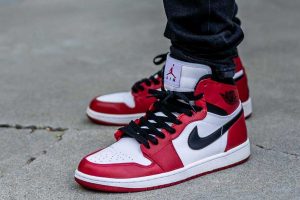
Air Jordan 1 Chicago WDYWT On Feet

When the Air Jordan 1 was created, there was not that much actual tech out there for basketball shoes. Nike changed this by incorporating Air technology in the midsole. Theoretically, this would help with cushioning.

The reality is that previous Nike hoops shoes such as the Air Force 1 have a lot more of that “air” feeling in the midsole. Although the tech is there on the AJ1, that isn’t why the sneaker was good for basketball at the time.

Unlike the AF1, the Jordan 1 provides a slim midsole with more court feel. This makes them similar to the Converse and Adidas models that Michael Jordan initially wanted to wear. The goal of the AJ1 was not only to make a great hoops shoe, but also to sell MJ on Nike.

Of course, more than 30 years later, way better tech exists for playing basketball. The Air Jordan 1 is intended for casual wear at this point, much like many other retro sneakers. Still, in a pinch, the AJ1’s court feel, traction and ankle support can still function as a decent shoe for ball.

What the Air Jordan 1 Got Right About Basketball shoes

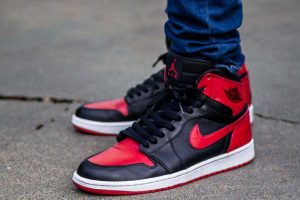
DMP Air Jordan 1 Bred On Feet WDYWT

The Air Jordan 1s excel in traction, court feel and ankle support. These elements stand the test of time as far as basketball shoes go.

The traction on the Air Jordan 1 stands up to modern basketball sneakers easily. Whether cutting left and right or running up and down the court, the circle pattern on the forefoot and flexible rubber allow for secure movement. This works well when playing on either indoor or outdoor courts.

The AJ1 provides a decent lockdown for the foot as well. The collar on the high helps secure the ankle and cup the heel, which adds a stability to the sneaker. Additionally, the traditional leather makeup of classic Air Jordan 1s adds to the sturdiness and durability.

As mentioned above, the Air unit on this sneaker is encapsulated in the heel. This fact, combined with an already low-profile midsole means that the Jordan 1 gives plenty of court feel. You don’t feel like you’re hovering over the ground, rather you get a stable and low to the ground feeling underfoot.

Reasons Not To Wear The Air Jordan 1 For Basketball

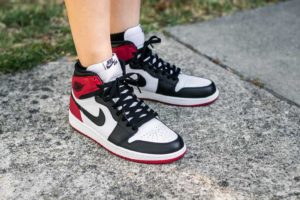
Black Toe AJ1

The Air Jordan 1 was created as a basketball sneaker, but struggles compared to modern hoops shoes due to heavy materials, outdated traction and tech and lack of cushioning.

Ever since the first Chicago and Black Toe colorways were rocked by MJ on the court, the Jordan 1 has been put to the test. For it’s time, the J1s cushioning and materials were par for the course.

Nike would go on to innovate even better technology however. Zoom Air for example provides the same court feel on modern hoops shoes with increased durability and longevity. Modern tech adds a responsiveness that is missing in earlier b-ball sneakers such as the AJ1.

While the traction is quite good on the Jordan 1 (some might argue that the traction is the most enduring feature), the herringbone traction found on most modern basketball kicks is generally superior. Not by much, but enough to warrant looking at other pairs to play in besides the J1.

The heavy materials on the Jordan 1 can’t quite provide the same experience as flywire, flyknit and other current variations found on modern hoops sneakers. Modern basketball shoes are designed to provide even better lockdown while still being flexible and lightweight. This is a balance that had not yet been achieved in the 80s when the J1 first surfaced. Newer shoes also improve on the lackluster ventilation found in the old AJ1.

Probably the biggest failing of the Air Jordan 1 is the cushioning. The sneaker just isn’t comfortable in the way a newer basketball sneaker is. For brief casual wear, Jordan 1s are perfectly fine. However, extended wear either on or off court proves to be less comfy than a lot of other options out there.

Can You Play Basketball In Air Jordan 1 Lows?

While many sneakers function well for basketball, it is inadvisable to play in the Air Jordan 1 Low. The sneaker has the outdated design of the AJ1 high and mid, minus the ankle support.

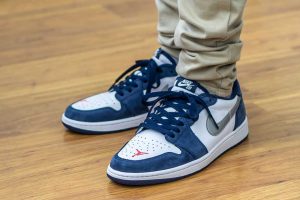
Nike SB x Air Jordan 1 Low Eric Koston Midnight Navy On Feet WDYWT

As mentioned above, one of the best things about the Air Jordan 1 for playing basketball is the ankle support. To this day, if you are forced to rock some Jordan 1s in a game, you can at least rely on your ankles being locked in.

This advantage is lost when transitioning to the Air Jordan 1 low. While some might appreciate the freedom of movement and perhaps increase in casual comfort on a pair of J1 lows, one of the main advantages of the model is stripped away in the lower cut. Cutting, juking, lateral movements and landing from jumps will all be impacted by the lower collar. Technically one could still play in some AJ1 lowtops, but there are better options.

For example, sneakers from the KD and Kobe lines have provided low top versions in the past that were perfectly suitable for playing while still feeling that support around the ankle. I personally played in the Kobe 6 often back in the day and never rolled an ankle! Well, almost never. Still, these sneakers made advancements in traction and ankle collar construction that helped negate the impact of a lack of physical material around the ankle.

So, What Are Air Jordan 1s Good For If Not Basketball?

The Air Jordan 1 isn’t the WORST sneaker for basketball out there, but it certainly isn’t the most optimal today. It IS however great for casual wear and collecting. The model holds its value and looks great on feet.

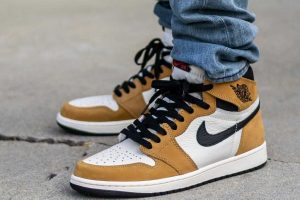
Air Jordan 1 Rookie of the Year Black Laces On Feet WDYWT
Air Jordan 1 ROTY 

Lets face it, most people rocking Air Jordan 1s probably aren’t wearing them on the court. The sneaker has become one of the most collectible shoes out there.

The timeless look of the shoe, the simplicity of the silhouette and the history of the AJ1 all tie into this. Even the less desirable colorways that come out manage to eventually sell out. There’s a reason the sneaker is kept in production even though Nike continues to innovate their sports offerings.

So if you ONLY own a pair of 1s, sure, play a game of basketball in them. However, if you have the means to purchase a different sneaker for playing a game in, by all means research the latest pairs from different brands to find the best tech for your playing style. But keep those 1s on hand for casual wear and your sneaker collection!

2022年9月7日星期三

Asics Novablast 3 Performance Review


I’m just going to say this upfront so you can stop reading and click one of the orange buttons below. The Asics Novablast 3 is the best all-around running shoe of 2022 so far. Why? A bunch of reasons. Keep reading and I’ll cover them in depth.


Asics Novablast 3

Release Date: September 13, 2022

Price: $140

Weight: 8.9oz

Drop: 8mm (23mm forefoot, 31mm heel)

Sizing: True to Size

  • Rundown: The Asics Novablast 3 is a bouncy, smooth-riding, do-it-all running shoe. We highly recommend you add them to your running shoe rotation.

Pros

  • Bouncy and Plush
  • Ride
  • Stability
  • Upper
  • Outsole

Cons

  • Slippy tongue

Pros

Bouncy and Plush

The FFBlast+ midsole of the Asics Novablast 3 is just awesome. FFBlast+ is a very good foam, as we’ve seen on both the Asics Glideride 3 and the Asics Gel-Nimbus 24. Both of those shoes are on our list of Best Asics Running Shoes in large part because of their cushion. The foam itself, combined with the midsole geometry of the Novablast 3, creates the fluffiest, bounciest iteration of FFBlast+ to date.

The valley down the middle of the outsole also circles around the forefoot allowing the FFBlast+ foam to expand and fill the space. This results in both plush, pillowy protection on landing and a bounce back that’s more typical of shoes sporting a composite or TPU plate. It’s also more bounce than you typically get for the $140 price point (running shoes at $140 used to be $130 but thanks to inflation here we are — insert sad face emoji of your choice).

This is the kind of midsole that feels great whether you’re running 3 miles, 6 miles, or 10 miles, chasing kids around a theme park, or just casually walking the streets. It’s an ultra-versatile setup that feels amazing.

Ride

The rocker on the Asics Novablast 3 isn’t super pronounced. It doesn’t swoop down at an angle like Asics’ top-of-the-line Metaspeed Sky+ marathon racing shoe. But, though it doesn’t look too rounded, the ride is super smooth. Touch down to toe-off is extremely smooth and the shoe feels like it’s helping you along the way. It’s the type of ride that makes you feel like you aren’t working quite as hard any time you pick up the pace.

Stability

Look down at the Asics Novablast 3 from above and you’ll see that the midsole naturally provides four generous outriggers. It flares out (without looking ugly or fat) at the lateral forefoot and heel and the medial forefoot and heel. Quick turns or jumping over obstacles doesn’t even register as anything remotely difficult. You can even move quickly from side to side and feel pretty secure. This sort of security is not normal for a running shoe this bouncy.

Upper

The recycled mesh upper is super comfortable and practical. Think air jordan 37 level of comfort. It lets in a ton of air, keeps the foot secure, but never feels anything but light and roomy. It’s an upper you stop thinking about as soon as they’re on your feet…it just gets out of the way and does its job.

The fit of the Asics Novablast 3 is narrow at the heel but widens nicely in the toebox. If you’re a wide foot with a wide heel, be careful and try these on before buying. Everyone else should be able to go true to size without an issue.

Outsole

When I first got the Asics Novablast 3, I worried a bit about the outsole. There’s plenty of rubber but the pattern doesn’t look like it would bite the pavement. Surprisingly, the thing gripped impressively. Only a ridiculously mildewed section of boardwalk caused any slippage (it does that with almost every road shoe I test). Otherwise, I could fly around in wet, humid conditions with reckless abandon and count on the traction to keep me from slipping.

If you run on a lot of dirt, cinder, or do a fair amount of road-to-trail running, check out the soon-to-be-released Asics Novablast 3 TR. It replaces the standard road outsole of the Novablast 3 with lugged traction that should increase the Novablast’s versatility even more.

Cons

Slippy Tongue

This is a relatively small complaint and it may not happen to everyone, but the tongue on my right shoe was always slipping to the lateral side of my foot. Yes, the tongue is gusseted, but the mesh gussets didn’t hold it in place well enough.

I’m not sure if a lace loop on the tongue would solve the issue but that would have been a nice addition. As it is, I’ll likely cut a small lace pass-through in the tongue with an Exacto knife to keep my right tongue from sinking to the side.

However, this isn’t a major issue and I wouldn’t let it dissuade you from buying an otherwise perfect running shoe.

Asics Novablast 3 Summary

The Asics Novablast 3 is just about the perfect shoe. After this review, it sits atop our rankings as the best running shoe of 2022. The combination of bounce, impact protection, breathability, stability, smooth toe-offs, and lack of weaknesses cement its status. It also doesn’t hurt that the Novablast 3 looks spectacular. If you only buy one running shoe this year, make it the Asics Novablast 3.

2022年9月5日星期一

Nike Kyrie Low 5 Performance Review

 The Nike Kyrie Low 5 nearly has the same tech specs as the previous Low release. You get most of the same performance with a change of materials.

Release Date: 2022

Price: $120

Athlete: Kyrie Irving

Total Score

I enjoyed playing in the Kyrie 8; it’s probably my favorite performance model of the year. The Kyrie 8 was a departure from the rest of the Kyrie signature line because it’s a very well-cushioned model. When I saw the Kyrie 5 Low, I thought it was just a low version of the Kyrie 8. Visually they’re very similar, something that hasn’t happened with the Kyrie Low line (until now).

Aesthetically, I think this was a good move. The Kyrie 8 is a very attractive model, and the Kyrie 5 Low just streamlined everything and made some slight improvements.

Performance-wise they are very different models. The Kyrie 5 Low switched out the cushioning from the signature model and reverted to the usual Kyrie Low setup: Zoom Air in the forefoot and a foam midsole. So, going into my testing, I wasn’t sure I would like this shoe. But let’s jump into the review and see how they held up (check the video above to see the short review)

Traction

The traction, as in the Kyrie 8, is excellent. They both have similar traction patterns, and this version was just as good. You get grippy multidirectional coverage that is perfect for the agile, streamlined look and feel of the shoe. You feel speedy and shifty in the shoe, and the traction pairs with that perfectly.

Cushion

The cushion is low profile and reactive. Very different from the Kyrie 8. This is not a bad thing necessarily or even a downgrade. It’s just a question of if this setup fits your playing style. This setup is optimal for court feel and moves like sprints, crossovers, speed changes, etc. It is not great for absorbing impact after jumping.

You have a Zoom Air unit in the forefoot and nothing but foam in the heel. I liked the setup very much. But, I’ll reserve them for playing on parquet floors. I’m 6’3″, 230 lbs, so when I play outdoors, I need a bit more cushion, but I love playing low to the ground and feeling speedy.

Materials

The materials are almost the same as those on the Kyrie 8; there are just fewer of them. The shoe features a mainly textile upper, which is lightweight and supportive. It’s nothing premium, but it doesn’t feel cheap either. You also get some “leather adjacent” details that make this shoe not feel cheap.

The one big difference between the two models is the tongue. The Kyrie 8’s tongue was polarizing. It was puffy like a ’90s skate shoe but super comfy. On the Kyrie 5 Low, you get a soft tongue as well, but this version is textile and much more subtle. Also, the shoe laces are cheap, but you can switch those out.

Fit

The Kyrie 5 Low fits perfectly 1 to 1. If you like that glove-like fit, you will like these very much; if you have had issues with this in the past, you should try them on or go up half a size.

Support

Support is fantastic. The Kyrie 5 Low inherited the Kyrie 8 Dynamic Strap System, which works well in this model. Instead of having four anchoring points, the Kyrie Low 5 has 2, but it still gets the job done. On top of that, you get a good heel counter and the overlays on the medial and lateral side of the shoe boost containment.

Aside from that, the wide forefoot and the stable cushioning setup add to the shoe’s support and to the feeling that you can pull off any type of move on the court with no issues

Overall

The Kyrie is an excellent performance basketball shoe. Now, is it a basketball shoe meant for every type of basketball player? No. The shoe has some intentional “weak points” to cater to a specific playing style. You wouldn’t use a catcher’s mitt to play in the outfield, right?

2022年9月1日星期四

Puma TRC Blaze Court Performance Review

 The Puma TRC Blaze Court is another great performance basketball shoe from Puma. The cushion is its biggest strength and materials are its biggest weakness.

Release Date: 2022

Price: $120

9/10 Total Score

Puma has become my favorite basketball shoe brand in recent years. I dig their aesthetics, I feel unconventional when I wear them, and they tend to perform great on the court. I’ve been able to play in the Puma RS Dreamer, the Puma RS Dreamer 2, the Puma Clyde All-Pro, and the Puma MB.01, all very different shoes, all great.

I have to say I was excited when I got to test the new Puma TRC Blaze Court, especially because at first glance, it reminded me of a beefed-up version of the Puma Clyde All-Pro. But there were some new performance features added that I’d never experienced. First, a new cushioning system. Second, new support features. And third, the materials seem very different from the Puma Clyde. So did this new model live up to the high standard Puma has set? Let’s find out

Traction

Traction is one aspect of the shoe I was fairly certain would be great. Puma has some great rubber compounds and every Puma shoe I’ve worn has had very good traction. Plus, the traction pattern they chose for the TRC Blaze Court had a great chance of being awesome: multidirectional herringbone.

Turns out that I was right to think the traction would be good. In fact, the traction was spectacular. The shoe stopped on a dime with every type of move I threw at it no matter the surface I played on. Puma tailored the traction to every part of the foot and to what type of movement you’re most likely to generate in each section.

For example, in the forefoot, you’ll mainly see traditional herringbone. So you get coverage on forward and backward motion with some lateral coverage as well. But at the very tip of the forefoot, the herringbone turns 100% horizontal giving you better coverage for forward and backward moves. This is the part of your foot that you’ll use for moves like stepbacks, push-offs, and hesitations, and that is the type of traction you want to help you pull those off.

The traction is primarily parallel on the lateral side of the shoe. This configuration is great for lateral movements. What do you use that part of your foot for? You guessed it, moving laterally. Sliding on defense, crossovers, etc. are well covered so your foot can push off with ease.

One thing to keep in mind is that outdoor durability may be an issue. The rubber compound probably won’t hold up great after a while outdoors, especially if you play on very abrasive surfaces. I ripped a chunk out of mine after playing a couple of times outdoors, but for now, I chalk that up as a fluke.

Cushion

The Puma TRC Blaze Court features 2 cushioning systemsNitro foam, which we’ve seen before, and Trinomic cushioning, which we’ve also seen before, but not like this.

Trinomic cushioning is a setup that Puma used back in the day. That version was similar to Reeboks DMX cushioning. It featured hexagonal pods that resembled a bee hive. It was supposed to offer the “holy trinity”: cushioning, flexibility and stability. But, Trinomic seemed to be an air-based system, and that’s nowhere to be found on this shoe.

What you get here is a dual-density foam setup, and although the Trinomic cushioning doesn’t look like the old Trinomic it’s bouncy, flexible, and stable. So, I don’t really care that it doesn’t look like the old Trinomic.

The blend of Nitro and Trinomic felt akin to adidas’ Boost. You get a ton of impact protection with a good amount of responsiveness. And, while you do ride high in the TRC Blaze Court, the shoe remains very stable. You do lose court feel, however, so if that’s what you are looking for in a shoe, you might want to check out another model.

Materials

Materials on the Puma TRC Blaze Court are functional and that’s about it. If I were suggesting upgrades to the shoe, materials would be my main focus. The upper is built entirely with textiles of different consistencies, with two rubber reinforcements (per shoe).

There’s a softer mesh over the toe box and across half of the midfoot, and a tighter woven mesh in the other half and heel of the shoe. There are also felt reinforcements in high-wear areas that add some design pop. The rubber reinforcements are on the lateral side of the midfoot and the heel to boost support and containment.

All of these work great on the court but the shoe doesn’t feel premium in any way, which doesn’t do the shoe justice. They could have done something similar to what they did with Jordan 37 which does not feature premium materials perse but the materials chosen make the shoe look and feel more premium.

Fit

The shoe fits great, if anything it’s slightly snug, and takes no time to break in. The 1-to-1 fit enhances the shoe’s support and lockdown on-court. But if that type of fit has given you issues in the past, you might want to go in-store and try them on or go up half a size.

The insole is nothing special, but there’s some padding in the forefoot and some nice heel padding and sculpting that make the shoe feel comfy from the get-go.

Support

Support is another standout feature on the Puma TRC Blaze Court. The shoe features a wide base in the forefoot, a TPU torsional plate in the midfoot, a pair of lace cables, a heel counter, and the aforementioned rubber containment features on the upper.

They all work well together to keep your foot in place as you play without feeling restricted. The two rubber pieces on the upper are different densities to offer targeted support: the heel piece is harder and acts like a roll cage to keep your heel in place while the midfoot piece is softer and more forgiving to allow a bit of stretch on lateral movements while keeping you on the footbed.

The wide base and the actual formulation of the midsole foam make for a stable ride, and the different weaves of the textile upper allow flexibility or containment where you need it.

Lastly, the shank plate. While it’s not the most substantial shank plate out there, it offers torsional support and adds some spring to your step.

Overall

I think the Puma TRC Blaze Court is a great shoe. The simplistic analysis of “a beefed up Puma Clyde All-Pro” is not far off. The Puma TRC Blaze Court might not be an all-time great basketball shoe, but I think it will easily make our list of the best basketball shoes of 2022.

Puma has become the most consistent brand in the basketball shoe space which is no easy feat. Models like the TRC Blaze Court just keep boosting Puma’s rep. If you want a shoe that does everything well and excels in cushioning, the Puma TRC Blaze Court is a safe bet.

2022年8月31日星期三

Saucony Endorphin Speed 3 Performance Review

 The original Saucony Endorphin Speed was a 2020 shoe of the year candidate and championed by some reviewers as Saucony’s best shoe ever. While I wouldn’t go that far, I did think the original Endorphin Speed was a very good shoe. The second iteration was basically the same shoe so I didn’t even take the time to write a full review. However, the Saucony Endorphin Speed 3 tweaks the winning formula to create the best Endorphin Speed yet.

Saucony Endorphin Speed 3

Release Date: August 24, 2022

Price: $170

Weight: M 8.1oz, W 7.2oz

Drop: 8mm (28mm forefoot, 36mm heel)

Sizing: True to Size

  • Rundown: The versatility of the Saucony Endorphin Speed 3 means it works for any kind of running. It also offers a bouncy, stable, and comfortable ride.

Pros

  • Bounce
  • Versatility
  • Stability
  • Fit

Cons

  • Wet traction

Pros

Bounce

The Saucony Endorphin Speed 3’s PWRRUN PB feels slightly softer than the previous Endorphin Speeds. It’s still not as cushy as jordan 37 but it’s got a great plush feel that bounces back quickly.

Part of the pop you experience can be credited to the new winged S-curve nylon plate. It’s just a bit more springy than previous iterations and an absolute rocket during track workouts or during uptempo runs. The Endorphin Speed line continues to boast the best nylon plate in the running industry.

With the PWRRUN PB midsole and the nylon plate working together you won’t waste any energy. All the force gets transferred through your footstrike and pushes your foot back up into the air quickly. That tech, along with Saucony’s Speedroll midsole geometry, makes keeping up your cadence (how quickly your feet hit the ground in succession) much easier. It feels like you get a nice push with each step. If you like to feel bouncy, the Endorphin Speed 3 is a great choice.

Versatility

Though the Saucony Endorphin Speed 3 is the daily training or workout version of the Saucony Endorphin Pro 3, the Speed 3 is the more versatile shoe. Long slow daily miles, track work, tempo runs, and even races are all doable in the Endorphin Speed 3.

Could you run a marathon in it? Yes. In fact, I’d recommend it as a marathon shoe for those that don’t like the stiffness of a carbon fiber plate in their shoe. You still get a plate with great bounce but your feet don’t have to do near the work to flex the plate.

The Endorphin Speed 3 can do anything you need it to…but be careful on easy days as it’s a quick shoe so you may speed up unintentionally.

Stability

The nylon plate in the Saucony Endorphin Speed 3 introduces an extra stability feature that feels great underfoot and continues the Endorphin Speed’s ability to provide great stability at high speeds. The nylon plate includes wings at the midfoot on both the medial and lateral sides. They extend all the way to the edge of the midsole so can see them peeking out.

This extra support at the midfoot really helps the Endorphin Speed 3 take fast corners with no wobble. It also provides stealthy arch support for those that need it. If heavy overpronators are looking for a faster shoe, they should try the Endorphin Speed 3. It’s incredibly supportive for being so fast which is a rare find.

Fit

The fit of the Saucony Endorphin Speed 3 is great all around. The heel features excellent lockdown while the midfoot and forefoot open up to be more accommodating. Wide footers should get enough room by going up a half size while most people can buy their typical size (check here to see if Saucony introduces wider versions at some point).

The upper is super breathable and hugs the foot while expanding as your foot expands on long runs. The tongue is slightly too short but honestly that’s a nitpick, because it’s gusseted and protects the top of the foot from any lace pressure.

It’s a great fitting shoe that you can slip on, and leave on, for hours.

Cons

Wet traction

It’s tough to find anything negative to say about the Saucony Endorphin Speed 3. Other than the short tongue, the only thing that bothered me was the wet traction. I had some slippage on wet boardwalks and some muddy sections of a greenway after a huge rainstorm. There aren’t many shoes that can handle those particular tests without some slippage…and the slippage from the Endorphin Speed 3 is minimal.

The slippage is likely due to the ample exposed foam on the outsole. That’s a trade I’m willing to make because the exposed foam is helping the overall ride and bounce. The exposed foam on my pair has taken some damage but is proving to be more durable than most exposed Pebax-based foams that typically take damage easily.

Saucony Endorphin 3 Summary

The Saucony Endorphin Speed 3 is a near-perfect everyday running shoe. Its versatility means you can use it for any type of running and it’ll be well-fitting, comfortable, stable, and bouncy along the way. Even with minor wet traction issues, the Endorphin Speed 3 will easily make our Best Running Shoes list.

2022年8月29日星期一

Jordan Luka 1 Performance Review

 The Jordan Luka 1 is one of the best performance basketball sneakers of 2022 (so far). There’s a lot to get excited about with this highly anticipated Luka Doncic signature sneaker.

Colorway: Black/Metallic Silver

Release Date: 2022

Price: TBA

 
8.5/10
Total Score

Luka Doncic used the Air Jordan 37 and its low-top version for most of the 2021-2022 NBA Season. Once in a while, he would swap those out for the Jordan Zoom Separate. Then, at the end of the season, he broke out his first signature sneaker, the Jordan Luka 1.

Traction

The traction ties all the performance features together. It is the foundation of all basketball performance sneakers. The outsole on the Jordan Luka 1 is made of translucent rubber and works well with its multi-directional pattern to cover all your movements and changes of direction. Indoors is where it performs its best, even with dust. The pattern is raised enough that it isn’t an issue after wiping. Outdoors, however, was a bit different. There was slight slipping in the forefoot area that needed wiping, and the translucent rubber can’t be depended upon to last for a long time.

Cushion

Jordan Brand sells us their newest foam with the Jordan Luka 1. That new foam is called Formula 23. What you see on the exterior is the carrier foam and the real moneymaker is housed inside. There’s some space between the Formula 23 and the carrier, so when pressure is applied, it expands and contracts accordingly. However, if you’re expecting a Zoom Air-type experience, you might be disappointed.

Something to note is that there was a noticeable difference after extensive hours of play. The forefoot felt lower than the heel. This might be that the foam is molding to the foot or bottoming out. The insoles are standard Ortholite.

Materials

The materials in the Jordan Luka 1 are not premium whatsoever. They’re lightweight, consisting of textiles with fuse overlays and some synthetic leather in the heel and eye stay areas. They’re lighter than the Nike KD 15, a lightweight shoe on foot. FlightWire wraps around the whole upper for additional support and lockdown. The ankle collar material is soft and makes it easy for you and me to get our feet in and out of the shoe. The tongue is well-padded, comfortable, and rests nicely above the foot.

Fit

The fit of the Jordan Luka 1 is adaptable. Going up half a size works fine if you wear ankle braces or other accessories. If you have regular to narrow feet, going true to size should work for you. The shoe is accommodating, especially in the midfoot and forefoot areas. We can thank the tongue that’s slightly disconnected for that. There are only five eyelets that all work together efficiently to ensure that you quickly get your preferred fit.

Support

The IsoPlate system is unconventional yet functional, just like Luka himself. It does a few key things. First, it acts as torsional support. Second, concentrating it on the lateral side makes the shoe much more flexible than other shoes where the torsional plate is placed right in the middle. Third and most importantly, it aids lateral stability during defensive and offensive movements. You can make hard cuts without worrying if the shoe will give too much. The heel counter is also as solid as a rock in order to keep your heel locked in.

Overall

The Jordan Luka 1 provides a big bang for your buck, considering that it will fall in the $110-120 price range. Those who value traction (especially indoors), court feel, and an adaptable fit will enjoy the Luka 1 the most.