2021年9月14日星期二

Air Jordan 36 Performance Review

 36 years and still going strong. The Air Jordan 36 Performance Review is here.

Traction

The Air Jordan 36 continues what the Air Jordan 34 reprised — herringbone. Tried and true herringbone traction. Outside of a radial pattern, there’s really nothing better.

With herringbone you receive simple, yet effective, multi-directional tread. This usually works well against a variety of court conditions and the same can be said for the Air Jordan 36. I was able to take the shoe out to three different indoor courts — a local 24 Hour Fitness, a privately owned and operated gym, and a pristine NBA-sized court. No matter where I played the traction was consistently good every time. I did take them outdoors as well with the same result — really good traction.

The only downside is for those that do not have indoor courts. It’s pattern and rubber are thin, although thicker than the Air Jordan 34 and Air Jordan 35. You’ll see wear on the outsole pretty quickly. However, you’ll receive some great traction while it lasts.

Something to keep in mind is the area where the additional Zoom Air cushioning system is in place. This is implemented like the “old” Unlocked Zoom Air setups that were found on the Air Jordan 28 through 33. The issue with this type of setup is that there is a pit in the midsole to allow the cushion to move more freely. This area of the rubber is weaker due to it not being glued to a midsole like it would be on traditional basketball shoes. That weaker area can sometimes result in the Zoom Air unit popping and deflating. The same could happen over time with this shoe. Nike will warranty the product, but it’s something to consider before dropping $185 plus tax and shipping.

Cushion

Zoom Air is back, but this time around they’ve gone back to a full-length setup. Something we haven’t seen since the Air Jordan 31. However, this time around, the full-length Zoom unit is the strobel board, so it sits directly under the insole and closer to the foot. There is an additional, and more traditional, forefoot Zoom Air unit located in the forefoot. The setup is similar to the Nike KD 13 with the exception of the bottom loaded forefoot Zoom Air protruding from the outsole a bit. This is to make the Zoom Air feel even springier than it already does — acting like a piston under-foot.

The setup is very well cushioned while maintaining court feel, but there is a wobbly feeling underfoot due to the protrusion. You get used to it rather quickly. Personally, I prefer the previous unlocked Zoom Air setup from the Air Jordan 34 and 35. Those models offered a wide stable base along with massive Zoom units under the foot. You received great stable and responsive cushioning without the slight wobble.

This isn’t a deal breaker for me, but I do feel like this was a bit of a regression in terms of design. The Air Jordan 34 and 35 perfected the usage of Zoom Air. The Air Jordan 36 feels more in line with what Jordan Brand was doing a few years ago. If they would have used both Zoom Air units just like the KD 13, then I think these would have been even better than they already are.

Materials

The main material featured is a leno jacquard weave. Visually, it might be a bit jarring to some. The build is see-through, yet, it’s supposed to keep you supported during gameplay.

The leno jacquard weaving, despite how it looks, is deceptively strong. It looks like dental floss but has the strength of more traditional jacquard builds. Outside of sb dunk , this type of weave is used for produce bags (onions, potatoes, cabbage), shellfish bags (oysters, mussels and clams), firewood bags, curtains and drapery, mosquito netting and even clothing. The type of weave provides strength, but the yarn used will enhance its strength — which is what we have here. Lightweight, breathable and incredibly strong.

Fit

The Air Jordan 36 fits true to size, but might be on the narrow side for some. If possible, I recommend trying the shoe on in-store. If you wear orthotics or an ankle brace, make sure you bring them with you when you try the shoes. You’ll need them to get the proper size to accommodate them.

Lockdown was solid all the way through. From the forefoot all the way up to the ankle collar. No issues whatsoever.

Support

All the support features you need are there. Internal heel counter. Midfoot shank plate. Secure 1-to-1 fit. They even have a fairly wide base. The only issue was the protruding forefoot Zoom Air. It has a wobble that you’ll notice until you get used to it. Once that’s done, you’ll be good to go.

Overall

The Air Jordan 36 continues the lineage of high octane performance driven signature footwear that started 36 years ago in 1985 with the Air Jordan 1. While I still feel the Air Jordan 34 is the best basketball shoe Jordan Brand has made since the Air Jordan 28 and 29, the Air Jordan 36 is close behind. I’d definitely take them over the Air Jordan 35 without a second thought. However, after playing in these, I can’t help but wonder what the Air Jordan 38 has in store.

2021年9月9日星期四

Curry 8 Flow Performance Review

 Boy was I excited for this one – and you should be too! Presenting to you my comprehensive, outdoor-based Curry 8 performance review.

I don’t usually like to go all the way in calling a shoe a “next-gen” shoe due to its innovations tech-wise or design-wise for that time period, but you know what? I could be able to pull it off with the Splash Brother’s first independent brand shoe, the Curry 8 Flow by Curry Brand & Under Armour.

Or could I?

I’ve been playing in these for a couple of months now (pretty much since they dropped at my local online retailer) exclusively on outdoor courts.

One’s a blacktop and the other’s a  synthetic rubber court. You know, those bouncy, rough surface courts that aren’t as unforgiving as concrete but still harder than indoor hardwood.

So to put all things into perspective, I’ve broken down the shoe for you from a practical standpoint. Is this a true “next generation” product that’s worth getting and lives up to the hype? Is it worth the $20 price increase? Is it a well-rounded shoe? Does it hold the test against regular outdoor play?

Let’s find out.

SIZING: UP 1/2 A SIZE

Let’s dive right into how these fit. Not an exaggeration – I don’t think anybody should go with their regular size when shopping for the Kyrie 7.

These definitely run small. I’ve seen some guys recommend going up a FULL size for a wider foot, and while I do think that might be overkill, going up half a size is recommended for most. Including those who have a narrow foot or a thicker, wider one.

Going up 1/2 a size myself and having a very wide foot, these still felt just a little too compact compared to how I’d ideally prefer. Although it might not be the size itself but how the internals of the shoe are constructed.

I don’t think anyone should go up a full size even if your toes are right at the edge after going up 1/2 a size. With such a minimal upper, minimal support features, and the way the shoe is sculpted, you’d most likely run into containment/lockdown issues.

GET READY FOR TOE BUMPS

Just like most people/reviewers were reporting – the shoe has a slight issue with keeping your foot 100% in place due to the incredibly minimal upper. Pair that with a slightly elevated heel area, and my toes were in a war.

Every time I did a quicker linear move (a stop-and-pop, a heel strike, etc.), my whole foot marginally shifts forward, resulting in an uncomfortable toe bump with the toebox.

Now, I’m not saying it’s a total dealbreaker as it’s not really felt while running or anything that doesn’t involve a quick/immediate linear motion, this still kinda spoiled what the shoe had to offer comfort-wise.

I’ve never seriously hurt my toes but after a longer session with these, those things definitely wanted some rest, that’s for sure.

But looking past that issue, the Curry 8 is comfortable. Very comfortable.

COMFORT: IT JUST FLOWS

Some say it might even be top 10 or even top 5 all-time comfortable. While I don’t think I’d be able to pick out just 5 or even 10 most comfortable shoes of all time, all I know is the Curry 8 is extremely pleasant to wear and play in, as long as I kept ignoring those damn toe bumps.

Firstly, it’s insanely light. I don’t know how it stacks up sheer numbers-wise compared to other light basketball sneakers but playing in these felt like I’ve got nothing on my feet. Ventilation is decent, every single heel-to-toe transition was almost ridiculously smooth and there’s some really nice foam padding around the ankle & achilles.

And then there’s the Flow cushion which, well, flows very nicely. But wait, there’s also an ultra-soft knit upper along with a very minimal, compression sock-like ankle collar which stretches out as much as you want it to, so the shoe is always super easy to put on.

Say what you want about the debatable choices durability or support-wise but, man, they absolutely nailed optimizing the fit and just how they feel on feet.

But perhaps it’s better described as not feeling anything at all, as at times I do manage to forget about those toe bumps and the experience becomes so smooth it’s not even funny. If someone would tell me the Curry 8 weighs 8 ounces and I didn’t know the truth – I’d probably believe them!

Bottom line, make sure to go up 1/2 a size, get some grippier socks on (ideally with a textured finish to minimize those toe bumps), lace ’em up tight, and enjoy the ride. If you value comfort – this is your jam.

The big thing about the Curry 8 was the fact that not a single inch of rubber was used. Not on the outsole, not on the midsole, nowhere. In fact, there’s no such thing as a distinct outsole & midsole here as the whole white bottom piece is made of lightweight foam.

With that came the concerns about the durability and effectiveness of the outsole, as science would tell you foam is a lot less reliable compared to rubber and its properties are vastly different. Well, let me begin by saying the traction on these is DEADLY. I mean every single part of that word.

I don’t know too much about how this particular foam was blended but it sticks to the floor like glue. The stops are instant with these. Not a single inch upon a stop, cut, change of direction, you name it.

In my LeBron 18 review, I said the cushion setup used on that shoe might be approaching a point where it’s almost too much. Well, with the Curry 8 Flow, I’ve come across a similar scenario, just with the traction. How grippy is too grippy?

While these barely squeak at all (it’s foam, duh), the bite is so aggressive it almost feels like it could throw you off balance if you’d let it to. Imagine yourself running at 30 miles an hour and then completely halting without any easing into it. If you’d have the Curry 8’s slapped on, you’d probably fall with your face flat on the ground.

I think this is right on the edge of the limit. This is incredible traction. Anything more might just be too much. So while I wouldn’t be able to tell you my top 10 most comfortable shoes of all time, if I had to put together such a list but traction-wise, yep. The Curry 8 would be there.

OUTDOOR DURABILITY: PRETTY GOOD FOR FOAM!

But are they reliable for constant outdoor use? After all, most of us are still only able to hoop outdoors. While 2+ months isn’t really an ideal period to make conclusions on the shoe’s outsole durability, so far they’re holding up well.

Not ONCE I had to wipe the outsoles off despite playing in a worn synthetic rubber court or the blacktop. There is some visible damage in the forefoot area, along the lateral side, and in a few other high-use areas. A handful of lines of the pattern are completely burnt off but fortunately, I don’t feel affected by this.

As long as this foam sticks due to its nature and the core base of the traction pattern is left intact, these will probably hold for a while. Not top of the line durability, sure, but definitely more reliable than today’s average modern hoop shoe which is usually indoor-focused.

UA’s brand new Flow cushion debuts with the Curry 8 and while it’s nothing we haven’t seen or felt before, it complements what the shoe is trying to deliver extremely well.

If you’ve played in a Curry shoe once or twice before, this shouldn’t feel that different, though I have to admit more cushion is offered than in pretty much anything we’ve seen from the shoe line. The shoe also rides higher than a typical Curry shoe, so people used to minimal, low-profile rides might feel a difference.

This cushion accomplishes two main things. One, it offers the same usual formula you’re used to seeing on a Curry shoe: a very fast, responsive & stable ride, smooth step transitions, and a sense of court feel.

And two, it does all that significantly more comfortably than the rest of the Curry sneaker lineup. More impact protection this time and, although minimal, but a slight bounce feel underfoot.

The heel area compresses a little bit but never too much, so you’re just as fast as you’d be on any other Curry. It’s just a little softer, and a little more pleasant this time.

The forefoot area is lower to the ground and feels firmer. Not completely dead but you won’t feel any bounce or apparent cushion. It’s all about speed and precision up there.

But it’s the smooth running transitions and overall flow of movements that make this setup fantastic. The heel is slightly elevated while the platform is slightly curved up at the front and while this is nothing new, it seems that they really nailed it here in terms of precision.

This feels like a high-end runner that happens to have additional qualities of a basketball shoe. If you’ve happened to do some runs in a higher-end pair of runners, you know how smooth those can feel. The Curry 8 is right along those. It’s comfortable. It’s not overdone. It’s efficient. Stellar job.

The support department is where things get a little interesting.

Do I think it’s a failure in terms of delivering security? No. But I do think the shoe was made with a handful of specific playstyles & builds in mind. Not saying this is bad but it would be tough to call the Curry 8 a very versatile shoe.

It’s nicely balanced, sure. But I’m sure there will be several guys who will require more support than what’s offered here. And that’s just the truth.

There is a rather small plastic heel counter in place along with a sculpted achilles pad inside, so my heel was both nicely padded and cupped in a secure manner. No issues with heel slippage. The platform of the shoe is wide and almost flat, so overall stability isn’t bad.

There are also these synthetic overlays along the sides which help with lateral & medial foot containment and the foam itself extends a tad bit laterally, acting as a mini-outrigger.

The medial sections of the foam do come out a little more, which does help plant off the inside foot more confidently. There’s also a small torsional plate for some torsional rigidity.

I never personally reached a point where I thought this isn’t enough for me but I’d be lying if I said I’d like a little more structure ideally. The upper is so minimal and flimsy, there aren’t enough strong support features in place to hold your foot together if you’re heavier or you’ve got an explosive/athletic playstyle.

While I’m not a big guy, I’m an explosive guard and did experience a handful of slides out of the shoe’s footbed. Not the best ankle support either. The tiny outriggers and a stable base helps prevent bad stuff from happening but a larger outrigger could’ve been welcome to help catch the foot on a more awkward plant/step.

I feel like this setup is pretty much made for Curry as he wears his hardcore tank-looking ankle braces, so I guess he’s set. But for guys at the frontcourt, heavier players, or anyone who plays with a lot of athleticism, there are better options out there.

But we can’t take away what the shoe accomplished. It’s not like it’s not supportive at all, as it is. Comfort, speed, and mobility are the clear points of emphasis here. If that’s your cup of tea or it matches how you play – you’re in serious luck!

The upper is what you call “barebones” – a thin knit covers most of the shoe while the synthetic plasticy material is layered along the medial & lateral sides to help containment. There’s also some Fuse overlays along the toebox, the back, and a few other high-wear areas.

And the whole bottom is just foam. That’s it. No raw materials, no huge shank plates, no carbon fiber, no real structure. It’s comfortable, absolutely. It’s seriously light, fairly breathable, and feels like a joy to wear. Except for the toe bumps.

But this type of comfort and a runner-like build undeniably comes at a cost. I don’t see these as very reliable for consistent blacktop action.

A season or two, probably. I’m not seeing any damage yet but it only makes sense to think a knit with no real extra structure isn’t going to last as long as leather, nubuck, suede, or even a more structured synthetic would.

Is it a good buy for $160? Depends on what you’re looking for. You’re definitely getting maximum comfort and mostly solid performance. If you’re looking for “premium” materials, the knit used here is nice but that’s up to you to decide if it’s worth the $160.

No real use of genuine materials might also throw some people off but hey, if people are complaining about that now, I guess they should’ve complained much earlier as the Curry line has been using primarily synthetic materials for a while now.

The lacing system is traditional but the shoe is a one-bootie upper, meaning it’s a single piece of material. No separated tongue, nothing like that. Not that important performance-wise but something you should know.

For those who aren’t fans of one-bootie uppers, this one’s a great example of one done very comfortably. And the shoe isn’t a nightmare to put on like some other one-bootie shoes, so you should be fine.

So bottom line, your typical modern use of minimal synthetic materials is utilized all over the Curry 8. If you’re no newcomer to these types of builds – you shouldn’t be surprised with the shoe.

Curry 8 Performance Review: Play 3

The Under Armour Curry 8 Flow is a breath of fresh air, that’s for sure. It takes comfort, freedom, and mobility to another level but there are still ways to improve. I think it’s a near-perfect shoe for a Curry-like player. Very quick, on the lighter side, mobility and precision are the pillars of his game.

But for the rest of us, perhaps mainly the heavier & bigger players, or for those who have more of a high-flying style of play, you might need something with a little more structure.

The shoe is mad comfy but be aware of the toe bump issue. Traction is phenomenal, Flow cushion is very nicely balanced without taking away anything, support could be better but it works for what it is. The upper’s a lightweight knit with minimal reinforcements so while it’s very comfortable and efficient, it might not last as long.

You can take these outdoors. Even regularly. I’m just not sure for how long. If you’re planning on playing outdoors regularly and would like to future-proof instead, the shoes on this list are the best options.

The Curry 8 is a very interesting shoe, to say the least. If you’ve always appreciated a Curry shoe before and would like something a little more comfortable – this is a KD 14 on steroids. I’ll leave it for you to decide if that’s your thing!

2021年9月8日星期三

Nike Kyrie 3 vs 2 Performance Review and Comparison

 Executive Summary: plays almost exactly the same as the Kyrie 2. Similar firm cushioning and very good traction. Shoe starts stiff but breaks in. No real reason to buy the 3 when the 2 does nearly everything the same or better though.

Pros: traction, court feel, fit, support and stability, containment, very durable

Cons: traction pods protrude and cause a little bit of inconsistent traction in the heel, needs periodic wiping on dusty floors on Non pod portions, cushioning needs break in and is very stiff and firm like the Kyrie 7, materials start stiff but break in, not the best value out there especially now that sale time is upon us.

Sizing: true to size, very wide footers will probably want to go up half a size

Best for: guards looking who value response and quickness; players who liked the Rose 4

Buying Advice: wait for sales, Nike made a lot. $90 is fair, $65 is near the bottom. Or just buy the Kyrie 2

Weight


14.5 oz which is pretty average

Kyrie 2 is the exact same weight

Traction

If there is one thing you can say about the Kyrie line, it’s that it’s traction patterns look aggressive.

The main attraction of the Kyrie 3 traction is the use of traction pods in the forefoot that ride up the sides.


The rubber is softer and raised a millimeter or two from the rest of the shoe.

 The concept works and the pods do their job very well. The rest of the shoe is a blade pattern or modified herringbone and feels softer than the Clutchfit Drive herringbone but firmer than the Kyrie 2 rubber.  I wish the entire outsole was made of the pods’ rubber or Nike put some of these pods throughout the entire outsole like the AJ XX because on a few occasions I’d spin out at the heel since the forefoot stuck better than the rest of the shoe. This occurred even on pristine floors. Nitpicky I know.

One concern with the traction pods is durability and efficiency once they wear down. I think they will still work fine once they wear evenly with the rest of the outsole but expect more wear in that area due to the softness of the rubber.

Overall traction is very good overall but I feel the Kyrie 2 provided better consistent traction overall especially on dirty floors since it is the same rubber, pattern, and depth throughout the outsole. Neither required too much wiping but the 3 needed a few more wipes per session. Not quite top tier stuff but still good overall.

Cushioning


Here is the tech highlight of the Kyrie 3. The rest of the shoe is Phylon just like last year’s.

If you did not like the cushioning on the Kyrie 2, you will not like the cushioning on the Kyrie 3. Say with me again, if you did not like the cushioning on the Kyrie 2, you will not like the cushioning on the Kyrie 3. One last time..

Cushioning is very firm on the Kyrie 3 just like the 2. It starts off very very stiff but softens a little with break in. I could feel the Zoom a tiny bit just like on the 2. It is serviceable and responsive as Randy noted but I just prefer a little more softness in the forefoot because I have Morton’s neuroma in each foot.  The good news is that the neuromas didn’t flare up badly but I could feel some buzzing after an hour just like the 2’s. I prefer a more balanced cushioning feel overall and these are just a little too hard for my tastes. The set up feels almost exactly the same as the Rose 4 except the Rose 4 has a thicker PU insole. Very low to the ground and quick feeling.

*interstingly enough if you check out air jordan 36 see the Kyrie actually sits at nearly 18 mm which is higher off the ground than the Harden V1 or CLB. Of course that’s not accounting for the insole thickness which probably evens it out. Thanks reader Pflite*

Although this didn’t really affect cushioning much, these two changes make the cushioning on the 3 feel a smidge firmer:

Number 1


The Kyrie 2 featured Poron in the forefoot while this year’s does not. Hard to really tell a difference but to the touch Poron is softer.

Number 2


The Kyrie 2 had an ortholite insole while this year’s doesn’t have the ortholite markings so in guessing it’s not ortholite. Anyways, the name doesn’t matter but the Kyrie 3 insole is very thin and flimsy like a limp noodle (it can barely hold its shape when I took the pic) plus it feels slightly thinner towards the middle than the Kyrie 2 insole. It’s as if someone wore down the insole of the Kyrie 2 and put it into the Kyrie 3. That’s how thin it feels to me. On Adidas Boost models, the thin insole is fine since it has all that Boost below it but with this firm set up, Nike really should have given us a thicker insole.

If you’ve ever played in basketball ball in tennis shoes like the Adidas Barricade or even the Nike Zoom Vapor 9, that’s what the cushioning feels like. Actually the Zoom Vapor 9 has the exact same size Zoom and a similar if not thicker Phylon set up from heel to toe including the foam strobel.


However, the Nike SB Dunk feels better because the insole is thicker. If you want to improve the comfort level of the Kyrie 3, get a bigger size and put in a thicker insole to add a couple of millimeters more of cushioning.  Keep in mind that it might feel better underfoot but one or two millemeters isn’t going to fix any knee issues you might have.

Fit


I bought my true to size 11 and initially thought I should have gone up half a size. However, after playing in them a few weeks, true to size was the way to go. Even though I’m a wide footer, these stretched out enough for me. If you’re Fred Flintstone, you should at least try half a size up before deciding on the correct width though.

There is no movement in the forefoot, very little deadspace above the foot in the toe box and zero heel slip. Midfoot fit is still tight like the previous models but not deathly like the Kyrie 1.

After a few hours of break in time, you almost forget they are on your feet as the upper softens up. Almost

Even though the Kyrie 3 has a very good fit, the Kyrie 2 has an even better fit due to the strap that helped pull the ankle and heel back further.

Materials

In case you’re part of the Night’s Watch or need to defend Winterfell….


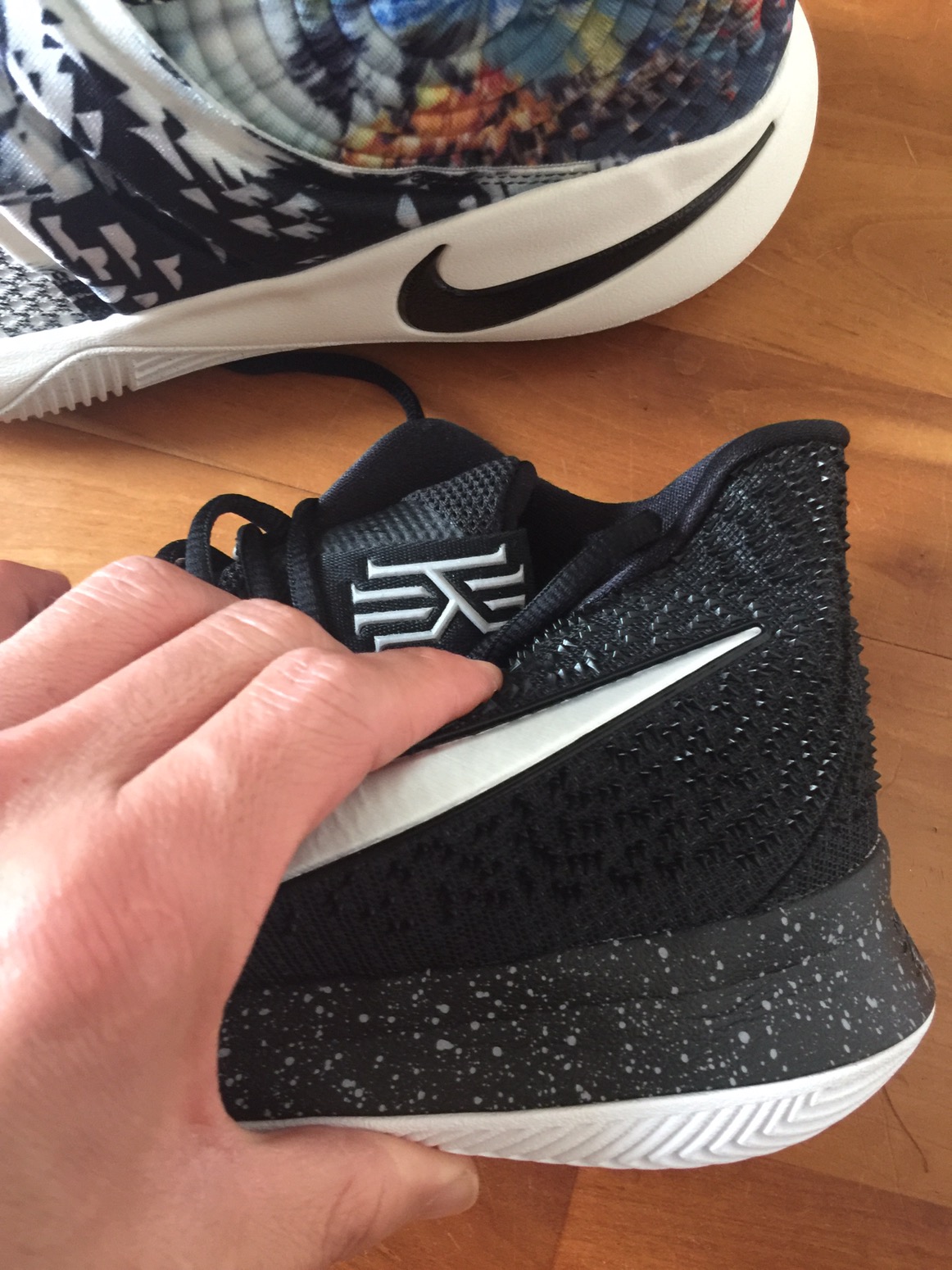
The materials start off stiff but soften up quickly. They don’t feel Flyknit soft or anything but they do soften up enough after a few hours of break in time. The spiked look doesn’t really convey a soft warm comfy feel does it?

The lateral side of the upper is a similar fuse  as last year’s model


Not cracker crispy like the Kyrie 1 but not definitely not Snuggles soft.


The medial side and toe box is mesh with a nylon backing and feels a lot softer than the lateral side. The front of the toe box does have a hard rand for durability as well.

I’ve noticed this is a trend these days as shoe companies have added strength and stiffness to the lateral side for containment and support while leaving the medial side soft for flexibility. Hmmm, maybe I did make a difference .(I’m kidding I don’t have that kind of pull)

Of course we can’t forget the featured marketing portion which is the forefoot flex area.

Across the top of the foot,  a long stretchy band flexes with your foot for support during quick cuts and sprints. 


Nike used a thinner mesh and Flywire to allow extra  flexibility at the forefoot.  I don’t it feel stretches at all but that thinner mesh allows for a more natural flex area. Plus it’s hard to quantify if it really works since the rest of the upper is so much stiffer than this little area.

If you’re big on materials and have to have that pure Flyknit or Primeknit or mesh feel, you probably will want to steer clear of the Kyrie 3. I think the materials are fine and don’t affect playability but every person has different needs and wants.

Support and Stability 


Support is good with the Kyrie 3 thanks to the fit, heel counter and stiffer fuse on the lateral side. Just plain and simple, solid support. As stiff as the upper starts off, it is plenty flexible like the Kyrie 2 and isn’t going to save any ankles


Nike continued with the curved outsole but didn’t choose to market it this time around.


It seems slightly less curved in the forefoot than the Kyrie 2. After not playing in the Kyrie 2 for a year you can feel a difference with the curved outsole but it doesn’t make a difference for me in terms of performance.

Also helping with the stability was the firm, low to the ground cushioning.

Overall just a solid supportive and stable shoe. Same as the Kyrie 2.

Containment


No surprises here as containment was excellent thanks to that stiffer lateral fuse upper as well as the raised midsole. Softer materials might be all the rage but there are benefits to using stiffer and stronger materials like Fuse.

Conclusion 

Not the best value out there but a good performer overall. The Kyrie 3 has great traction, a good fit with solid support and stability and very firm cushioning. I had no issues with aches or pains but then again don’t have knee or back issues (knock on wood). The Kyrie 3 just feels like a quick high cut tennis shoe for players that value lateral quickness over everything else.

Cushioning will come down to personal preference and if you didn’t like the 2 cushioning you will not like the 3. I’ll even qualify that statement with this; If you don’t like UA Charged you will not like cushioning on the Kyrie 3. Charged foam is easily thicker bouncier and softer. If you want to improve the comfort of the Kyrie 3, size up and swap out the cheapo insole.

Is the Kyrie 3 an upgrade over the 2? No I don’t feel it did anything better than the Kyrie 2.

Is it worth paying $120? No probably not. There are plenty of shoes out that at the $120-$130 range that do everything just as well or better than the Kyrie 3. Curry 2, 2.5, 3 all come to mind.  Plus it’s almost mid season so there are plenty of sales on earlier launches.  Do not buy these if you want a softer cushioning set up or if you want a Charmin soft upper material. 

I’m guessing Nike made a lot of these to capture the new Kyrie fans post championship. If Kyrie 2 sales are any indication, these should hit $90 under range soon and bottom out around $65. If you want a marginally better performing and cheaper shoe, stick to the Kyrie 2.

2021年9月7日星期二

The Archive: Nike Zoom BB Performance Review

 Let’s take a moment to appreciate the simplicity and beauty of the Zoom BB


The Zoom BB came out in 2007 when Steve Nash was near the peak of his powers and the BB was getting some serious team shoe time.
Why Nike only made three of the air jordan 36 is beyond me. I never tried the Fuse 1.5 but I’ll bet it performs as decently although it is only forefoot Zoom. Out of the BB I and II, I preferred the I because the upper had a tighter overall fit with no deadspace.  And in case you didn’t know both generations of the BB feature the same outsole and full length Zoom set up. I suspect a retro will be coming in the next year or two.
Pros: traction, cushioning, fit, support and stabilty, containment, low fast ride

Cons: piece in outer forefoot gets soft and containment suffers over time.

Best for: Guards

Sizing: true to size

Weight:


17.5 ounces so not a lightweight nowadays

Traction:
I remember the first time I played in these like it was yesterday. Just seriously loud squeak and stop traction.


I actually used these last week in my open league and prior to that, I played with these side by side with the Hyperdunk 2016 to compare the cushioning and the traction is still fantastic. It does require some wiping on dusty floors but it can still almost hang with the top tier traction set ups and still better than most.

Cushioning
Nike used a simple and innovative approach to making the cushioning a guards dream


Step 1: full length Zoom

Step 2: do not use any fillers such as EVA or Phylon. Before Pure Boost there was Pure Zoom

Step 3: remove strobel board and use cloth instead

Step 4: use Pebax to stabilize the Zoom yet keep it flexible and springy

Even the sockliner had a little extra spring to it

This is as pure of a Zoom set up as you’re going to get. Low profile and springy or every guard’s wishlist. No foam allows the player to feel the Zoom and eliminates any extra ride height.

Regarding the lows, I thought the set up was the same but upon further inspection it is heel (very small and short heel but thick) and forefoot Zoom. Still a great ride but not as springy from heel to toe. The only reason why Nike got rid of this set up could be due to the Zoom popping although I have never read of any but I could see it happening since you’re essentially stepping directly onto the Zoom.

Fit

The Kyrie 7 simply fit true to size. No need to size down or up to get a one to one fit because back then, there weren’t as many choices in materials. My normal size 11 fit perfectly length and width wise.

Sit back, let the basic lacing set up and mid cut do its job. No heel slip or movement side to side or front to back.


So simple, so effective, so so nice

Materials

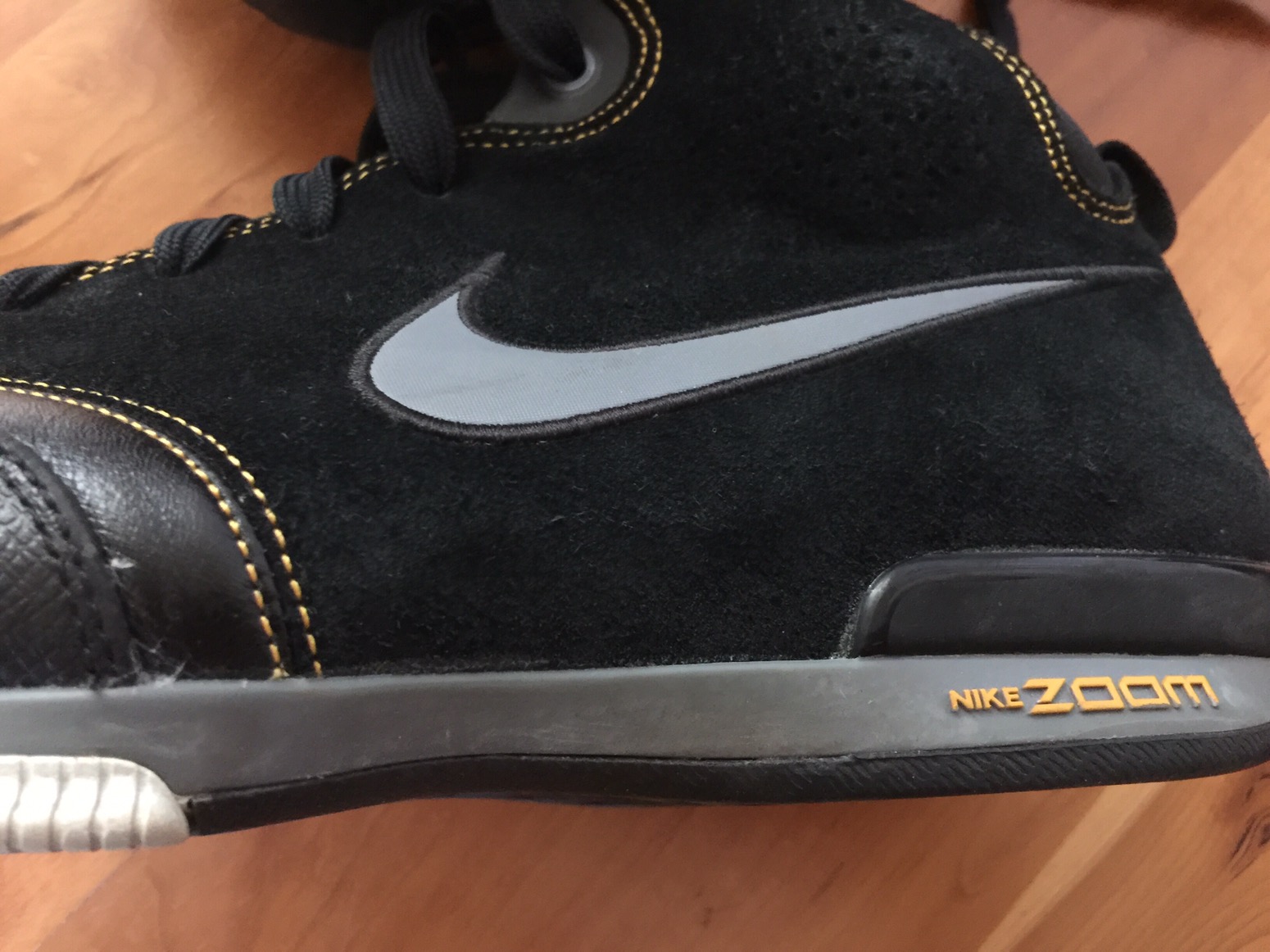
These are the suede version and although it isn’t my first choice in materials, it works.

The suede version is just softer and stretchier than the leather plus patent version and gets sloppier over time but these have held up well after ten years. I have the Tony Parker PE somewhere but I can’t find it

Support and Stability 

The leather version actually has more support than the suede because of the materials. I actually left the top loop undone on the leather pair because it was almost too restrictive. This Dunk  is a little more flexible and conforms to the foot like a sock.


Here you can see the simple heel counter.  Notice it only extends to the lateral (outer) side, similar to what the CLB 16, to save weight.

Low to the ground with a flat outsole, these just keep you planted to the ground. No worries of any instability.

Containment 

People think I’m crazy when I talk about lateral containment but look at the pic above and you can see it mattered at some point to Nike. Unseen, there is a plastic piece behind the upper that sits where that leather rand is. I’ve worn my BB down so it’s a little flimsy now but still miles better than the new generation of mesh and knits that have a total disregard for this performance aspect.

Conclusion

Do away with all the technical mumbo jumbo and marketing and just give me a shoe that performs like the Zoom BB and you’ll have my endorsement. There was no fanfare, no YouTube reviews back in 2007,  just word of mouth from genuine basketball enthusiasts like Niketalk. Even the Nike ad was simplistic.

QUICK IS DEADLY


Technology may have changed but it really hasn’t improved in a significant way in ten years and the Zoom BB proves it. It’s also why I don’t just pick ten shoes every year and give them a ringing endorsement.

2021年9月1日星期三

adidas Dame Lillard 3 Performance Analysis and 2 Comparison

 I apologize in advance, this isn’t a good flow to this post but there is so much going on with the Dame 3 that I wanted to cover*

Executive Summary: The Dame 3 feels like a step forward with improved traction and firmed up Bounce. However, it also feels like a half step back;  the heel fit is fickle even in the rear most position and the lace pressure gets painful back there no matter how you lace through the pegboard.  More padding around the ankle or wider laces would have really helped to make it a more comfortable all around performer. I recommend longer laces for better lockdown to utilize all the eyelets. Also the midfoot and back support is very stiff. Analytical Cubism and angularity at its finest. Photo by Pablo Picasso, shoe by Adidas and Dame Lillard

Of Adidas’s big three, Harden, Rose, and Lillard, I think Lillard is the most marketable; he’s very active on social media, comes off as authentic, doesn’t mince words, and has been loyal to Portlandia. One of the big selling points of the Lillard 2 was the price but Adidas opted to increase it $10 this year since Lillard’s stardom grew a bit after the Blazers’ playoff run last year. Is it worth the ten Dame Dolla increase? 

Here is my Lillard 2 Review from last year 

Pros: traction, cushioning, overall fit is good after break in, support, stability, containment

Cons: 
firmer and less bouncy Bounce than last year, lacing system works but not totally necessary, some very light ight heel slip even after getting lace set up correct, needs some break in time to make shoe more fluid but still stiff at the midfoot and back, lace pressure can get uncomfortable if using double eyelet system at midfoot as well as at the rear eyelet, longer laces are needed if you choose to utilize all the eyelets like I did

Best for: any position

Buying Advice: 
polarizing angular design isn’t for everyone. $90 or less is fair, $65 is near the bottom


Weight

Adidas wins 2016 for heaviest average weight per shoe and continues the trend in 2017. I personally don’t mind but I know lots of people do. 16.5 ounces is half an ounce more than the CLB and half an ounce heavier than the air jordan 1 high

Traction


If this pattern looks familiar, it’s because it has a similar blade set up as the Kyrie 2 but more linear and more blades.  The great news is that it works 

Thin pliable rubber check

Deep grooves check

Lots of points of contact check

Multi directional check 

Not much wiping needed at all and I felt covered on all moved and all directions. Not quite top tier but close enough. I felt this was a major improvement over the 2 especially on dusty floors. 

Well done Adidas!

Cushioning

Dual density Bounce is back and feels similar to the Lillard 2 but definitely firmer and slightly lower feeling in the especially in the forefoot. There is a slight heel toe drop this time around but not nearly as severe as the Rose 7. 


Adidas swapped the regular strobel board of the 2 (right) for a softer one which allowed them to lower the ride without losing too much Bounce (get it?) But that’s not all. 

Typically Adidas only cuts a hole in the heel but this time they cut some slits on the forefoot to allow the player to feel the Bounce a little bit more. I think one of my readers, S, asks about cutting the fiberboard strobel of the Rose 7 for enhanced feel. Guess Adidas read your mind S! 


Adidas also swapped out the thicker insole of the 2 and put in their more common thin insole. Same as the Crazy Explosive and Harden, not quite as thin as the Rose 7.  Swapping out the insole resulted in less step in comfort than the 2. Swapping the insoles does help with step in comfort but the 3 is still firmer overall. Plus the 2 insoles are more narrow than the 3 so they don’t really fit perfectly. 

I think a big reason everyone loved Bounce last year was because it surprised us.  Soft yet responsive and bouncy for a “budget” cushioning. Expectations can hurt or help a shoe so this year it meets expectations without exceeding them. Overall I found it a firmer than last year but still comfortable enough. However, it doesn’t have that same fun feel as the 2 though. I guess Bounce needs volume to keep that bouncy feeling.  For those keeping score, these are much firmer than the Hardens and CLB. The plus side to the firmer set up is a quicker feeling overall.

Fit


As Adidas continues on it’s never ending riddle of sizing, I bought my true to size 11 and 10.5 to find the right fit. These feel like they run a tad longer lengthwise than last year probably due to the thinner insole and thus more space. I recommended half a size down last year and I’ll say the same for the Dame 3. Wide footers can go true to size based on tightness preference since the mesh stretches a little. Ultimately I decided to go half a size down with the 10.5. 


Hey Mom look, no leather puncher ! But boy is it tempting

Adidas states the lace pegboard was Dame’s idea and it works(at least the rear three)…thank goodness it works or heel slip would have been terrible. In the stock set up with the top laces in the “neutral” position, I had serious heel slip. Moving it back to the second back and down help a little but still too much slip for me. I felt locked in with the rearmost position but it would loosen during play and still have some very tiny heel slip which is fine. The rearmost position was also the most painful in terms of lace pressure since there isn’t much padding in the tongue or around the ankle collar. As always with Adidas, I had to modify my pair somewhat to make them more comfortable so I added some moleskin to the tongue. Not ideal but it helped somewhat. 

The Pegboard
Being my curious self, I fiddled around with the lace set up for an hour and a half. I’m not kidding, what kind of cruel joke does Adidas want to play with anal people like myself?  Half the time was going back through the double lace hole set up which is akin to the Harden V1 set up but a little more user friendly. Still a pain in the butt, but effective because the laces don’t slip at all during play (there are downsides to this, keep reading).  One problem I noticed is that you may run out of laces if you choose the back positions if you don’t slip any of the midfoot holes. 
 This is the set up that ended up working best for me in terms of lockdown. I bought 72 inch boot laces and I still barely had enough to tie them. 


I suggest not double holing 
because if you accidentally pull too tight, those laces will just stay there and cut off circulation. Lace through one hole instead of two so that the laces automatically adjust to your liking. 

Does the pegboard work? 

The back three eyelets make a difference because they are used to lock down the heel from different angles but the midfoot eyelets (first two) don’t really make a difference where or how you lace them. 

I laced through the lowest holes of the midfoot eyelets as well as the highest two to see if I could tell a difference and I really couldn’t. The laces just pull the entire pegboard down onto the foot regardless of position. 

Adidas could have just used full length lace straps that they typically use that run all the way down to the foot bed which would cover all foot types or preferences. Laces automatically give you customized lockdown, that’s what they are designed for. They already used those straps in the forefoot of the Dame 3 already so why not the whole shoe? Instead of having to lace through the pegboard,  the lace straps could just feed through the it from the bottom of the footbed. 

I also think lockdown could have been improved by putting one eyelet higher up like they did on the Lillard 2. I always have issues with eyelets are are set too low

If Adidas really want to be efficient with modularity, they could have just made more eyelets at the top like the old days.. two or three holes near the ankle would have been enough. I only needed one extra eyelet to totally change lockdown on the CLB16. 

I feel Adidas just did this pegboard triangle for buzz/polarizing factor more than anything else. They have really been experimenting with different lace set ups so I guess the can claim to be the leading lacing “innovators”. I’m guessing you won’t see a return of the pegboard next year though. 

   Sometimes all you need to catch a mouse is a piece of cheese, no need to reinvent the mousetrap Adidas

Materials 


Fused Mesh which is exactly what it sounds like, mesh with Fuse. Nothing wrong with it since they fused high pressure areas of the mesh to strengthen the upper.  Soft where it should be, strong where it should be. There is a nylon backing along the entire interior as well. 

It doesn’t feel premium since it’s fused mesh but it works which is perfectly fine for me. Nike Dunk has to cut corners somewhere to make a $115 sig shoe. 

Support and Stability 

You can see the Dame 3 is slightly lower than the Lillard 2

This Dame 3 is a high lowtop or a low Mid whichever way you want to look at it. The majority of the support will come from the fit and the very firm external heel counter. There is actually an internal heel counter as well. 

Unlike the Mamba Mentality which can contort into my pocket for easy transport, the Dame 3 has a super stiff midfoot structure.It doesn’t flex at all even after break in. Some people will like the extra support, some will think it is too stiff and some won’t even notice it. Most shoes flex a little bit even if they have a shank but the Dame 3 is stiff as board midfoot and back. 

This was the best shot I could take with one hand. Looks like a car crash test

I feel the midfoot brace makes the shoe stiffer and slightly clunkier than the Lillard 2 on heel toe transitions. It keeps the midfoot and back from over flexing which helps prevent plantar fasciitis or other foot injuries but just doesn’t have that natural feeling. I like a more balanced blend personally. 

Stability is excellent as well thanks to the a very flat outsole and this rectangular outrigger 
Sticking with the angular theme I see Adidas

Overall support and stability is excellent on the Air jordan 36 even if the midfoot support is a little overdone. 

Well done Adidas!

Containment 

Adidas is getting more love from me lately because they have been addressing this highly overlooked performance aspect consistently. They must visit my site a lot 

Raised midsole across the entire footbed so a true foot bucket. My forefoot actually sits at the bottom of the ridges and my heel sits at about the middle to top third of the ridges. 


Notice how the ridges run up and down. This allows the “bucket” to flex more naturally. It takes a little break in to make this pliable but it doesn’t take long. 

In addition to the raised bucket, Adidas reinforced the  mesh in high stress high wear areas with fuse to limit stretch. And don’t forget about the pegboard, look how thick the synthetic leather it is. 

Your foot isn’t going anywhere on hard cuts .

Dame knows what he wants and Dame it, that’s what he gets..and gives to us. 

Well done Adidas!

Conclusion 

I really wanted to like these because I think these look different…in a good way. Very slim profile and the pegboard doesn’t bother me looks wise either.  The improved traction really got me excited and I liked the faster feel of the Dame 3 cushioning. However, the lack of padding at the midfoot and especially around the ankle really made the lace pressure uncomfortable. It feels like Adidas took the bootie of the Lillard 2 and just didn’t add any overlays or padding to compensate. I usually get over lace pressure pain but it never went away and I need to tie them tightly to keep my heel locked in. 

  I just never looked forward to wearing despite the performance improvements.  If your foot doesn’t fit the one piece bootie perfectly, then the laces have to do all the work to hold the heel down and back. I enjoy wearing the Lillard 2 more even if the traction isn’t as good (and you all know how heavily I weigh traction). It’s just a better blend of comfort and fit for me. 

   I also got frustrated with the pegboard because it works decently but Adidas didn’t bother giving us longer laces to accommodate all the lace options. I don’t mind the occasional tweak but I feel like every time I order some Adidas, they forget the French fries and I have to switch or change something  . I also don’t feel it works any better than a good standard set up.  I’m 99% sure this is the last we will see of this. #goodriddence

   I feel like the Dame 3 is one of those shoes that performs well in every catagory but just under performs as a shoe overall. Or maybe I’m just spoiled from my other shoes. 

    Everyone complains about Nike pricing because it’s easy to do but the Lillard/Dame 3 didn’t add anything this year to justify the $10 price increase. 

  • Mesh and fuse this year versus textile last year. 
  • Same cushioning but firmer

I guess Adidas justified the $10 with the pegboard but in all reality it’s because Dame got some quality air time last year in the playoffs versus GSW.  All companies use the strength of their brand and players’ brands for profit, that’s just how business works. Unfortunately at $115 and a late, almost mid season release, Adidas may have priced itself out within its own stable of shoes.  Why buy the Dame 3 when the CLB 16 is available for much less? Similar if not better traction, more tech, better feeling cushioning for $91 or less on Adidas.com. Even with a leather hole punch, it’s still around $100 before any coupon codes. Or get the Rose 7 or Crazy Explosive for similar prices. If Dame is your favorite player, that’s a different story altogether. But still wait to buy because these are sitting everywhere. $90 is a fair price and I see the bottom around $65 like last year.