2018年10月15日星期一

UA Curry 3Zero II 2 Performance Analysis and Review

Beauty is only skin deep..that’s a good thing to remember about this shoe but also life in general.
Pros: traction, excellent fit, low to the ground yet balanced cushioning, fantastic stability, containment, lightweight
Cons: no heel counter so support relies almost solely on fit and stability of shoe (which is excellent), unnecessarily ugly
Sizing Advice: true to size
Best for: guards who want full range of motion yet stable shoe
Buying advice: wait for a MyFitnessPal coupon or just wait and let me know when you see someone with these on. Guaranteed to hit discounts and outlets $60 is fair (what I paid) but should push $35-45 as bottom prices
Weight 12.5 ounces which is very lightweight for a mid and one ounce lighter than the HOVR Havoc Low (review coming for those as well trying to work through some issues with them mainly heel slip)
Traction
Yes
This traction pattern is great and works well on all surfaces. Not the strongest bite but the trade off is infrequent wiping (insert poo joke)
Call me a creature of habit but I still think the Curry 5 traction is a little better due to a better bite and even less frequent wiping. However these are no slouch at all and are definitely one of the better patterns this year.
Well done UA!
Cushioning
Charged in the heel and Micro G? Sounds like a good retro UA mix and it is pretty decent but it doesn’t feel anything like Clutchfit drive 1 or older Micro G. It feels mostly like a thinned out Curry 3 but with less feedback since it rides lower (less cushioning). It rides around 20-22 mm in the forefoot like the Curry 4. If you want low to the ground but more than adequate impact protection, you’ll really like these.
It is a very well balanced combo of court feel with a touch of bounce so I think a lot of players will enjoy the set up even if it isn’t Boosty or Zoom Air like. Could UA do better? Yep they have in the past but these do a good job overall. Just wish these had a little more fun factor but you get what you pay for. For what it’s worth I like this set up much better than the Havoc so far.
Fit
True to size so simple people!!
No dead space in the forefoot at all shoe just slips on and fits like a glove or sock or whatever you want to put on your feet.
It’s essentially a one piece upper with a slightly separated tongue but hugs the foot very nicely right out of the box. This is one of the best aspects of the 3Zero II
Well done UA!
Materials
Molded maxprene upper with zonal restriction engineered from within for maximum comfort & breathability -UA
Translation: Maxprene and mesh but mostly Maxprene. Maxprene feels like a stronger less stretchy version of neoprene and is very comfortable. If you could synthetic and neoprene had a baby together you’d probably get something like this.
No issues here
Support and stability
Support relies on the fit and the stability of the the shoe because there isn’t a heel counter at all. However, stability is OUTSTANDING for a number of reasons
First off the outsole is very wide and features a modified outriggerNo tippiness in the heel and it very wide heel to toe.
It’s one of those shoes that feels like it’s split right in half to keep the lateral side down and flat no matter what you do. Other shoes that felt this stable to me include the Air Jordan 1 and Curry 2. Despite no heel counter I just felt safe playing in these.
Whatever UA did, exceptional job making these feel so stable!
Containment
Nice raised mdisole
It is more flexible than I prefer but with the synthetic upper it does a good job on hard cuts
Conclusion
I had no intention of buying the 3Zero 2 mainly because I threw up on the screen when I saw it and couldn’t hit the add to cart button. However, after a few different colorways came out and another MyFitnessPal coupon popped into my email, I was like ok for $60 I’ll give it a shot and I’m glad I did. For $100 I wouldn’t buy it and neither would the rest of the world but for $60 . Life tip: retail price is what companies wants you to pay, it isn’t the price you should pay. #crazyrichasians
If you can’t get a MFP coupon don’t fret because I can guarantee you THESE WILL SIT and go to major discounts and discount outlets. No games by Steph in the 3Zero II, no major marketing and most of all they are fugly for no reason will allow everyone to cop a shoe that does almost everything exceptionally well with traction, fit and stability being the very high highlights.
If Basketball Shoes really wants to survive in the shoe business, it really needs to work on blending looks with performance. Only 10%-20% of buyers actually buy shoes for their intended purpose so to target just this small percentage of customers is not the right strategy especially when UA basketball lives and dies by one player. I wrote this years back and sure enough the 2016 3-1 lead disappeared and UA tanked (and is still recovering but getting better..UA you should really visit my blog more often). Seriously though a few tweaks here and there would have made the 3Zero 2 much better looking without sacrificing any of the performance aspects.
And knowing how my readers think, I’ll say this ahead of time, I’d take the 3Zero2 over the Havoc all day no questions asked, no refunds, thank you come again. It does EVERYTHING better than the Havoc except maybe support but the stability of the 3Zero2 makes up for it. HOVR might be the newer cushioning but I’m comfortable saying it doesn’t feel much better than Charged especially how it’s implemented in the Havoc and it certainly doesn’t give me any additional energy return. I’m trying to work through heel slip and breaking in the cushioning more before a final assessment of the Havoc.
In the meantime these get a first team rating

2018年10月9日星期二

Better Off-White x Nike Blazer: “Grim Reaper” or “All Hallows Eve”

Virgil Abloh’s latest Off-White x Nike Blazer Mid release consists of two Halloween inspired color options dubbed, “Grim Reaper” and “All Hallows Eve” as part of Spooky Pack.
After dominating headlines last month with his “Queen” collection for Serena Williams — complete with a brand-new Air Max 97 — Virgil Abloh is back in the public eye again, as official images of his two new Off-White Nike Blazers have been unveiled. Abloh’s remarkable propensity for never straying far from the limelight has continued ever since the release of his original “The Ten” collection in September 2017, and now his highly-anticipated seasonal takes on a beloved silhouette will ensure he stays there long into the fall and winter.
Entitled the “All Hallow’s Eve” and the “Grim Reaper” the two seasonal Blazers feature a deconstructed aesthetic, two-tone color palates and Abloh’s instantly recognizable bold branding.
The “All Hallow’s Eve” offers a halloween-ready combination of cream and orange, while the “Grim Reaper” opts for a spooky black and white. The former is notable for utilizing a retro color scheme not seen before on Off-White releases, while the latter’s translucent midfoot stands out even more than usual due to its dark black base. Both shoes also feature Virgil’s Helvetica branding on the medial midfoot, and are completed with a signature zip tie
Inspired by the dark look of the infamous grim reaper, the shoe features a Black upper with an oversized White Swoosh, Orange detailing and signature Off-White zip-tie in Light Blue.
The “All Hallows Eve” comes in a ghostly Cream colored upper with a Orange Swoosh logo, Abloh’s signature bold branding text and Light Blue zip ties to compete the Halloween theme.
Comparing both shoes, which would you consider the better release? Cast your vote below, and leave your reasonings in the comments section.

2018年10月5日星期五

adidas Pro Bounce Performance Review

adidas Hoops has been pretty quiet in 2018. The brand hopes that will change with the introduction of the adidas Pro Bounce. This is one of the best outsoles we’ve gotten from adidas since the Harden Vol 1. Its rubber compound feels nearly identical to the kd 11 and it acts like it as well. Spiral patterns usually work well but the bite these offer is on another level. There were no issues no matter which court I played on. I just had solid traction from start to finish. It’s capable of handling outdoor use as well which is a big plus.
If consistent and reliable traction is your thing then the adidas Pro Bounce should be on your list of options when shopping for a new pair of basketball shoes.
Bounce cushion appears to be replacing Boost in most of adidas’ basketball models. It’s replaced Boost in adidas’ awful D Rose 9, and it looks like it’s completely replaced the Crazy Explosive line altogether. It’s almost like adidas is trying a little harder to distinguish the two cushions — which one is its premium offering and which one is its more affordable option.
Now, if you’ve worn Bounce before then you won’t be disappointed. Bounce offers a slight bounce in terms of feedback underfoot while retaining a ton of court feel. It’s one of the most well-balanced rides from a foam currently available on the market. It did leave a bit to be desired when I took the Pro Bounce outdoors, so for that I’d rather grab my Harden Vol 2, but for indoor use I think it’s perfect for players from the 1 to 5 spot.
adidas applied ForgeFiber, a lightweight mesh with additional stitching for reinforcement and strength, on the upper of the Pro Bounce which is similar to the Harden Vol 2’s build. And like the Harden Vol 2, it feels a little cheap in-hand and on-foot. However, ForgeFiber works just fine. It’s breathable. It’s lightweight. It moves with the foot rather than against it. It requires zero break-in time. But it still feels a little cheap — it’s something I’d be okay seeing on a $90 shoe instead of a $120 shoe. Is it a deal breaker? From a performance perspective, not at all. If you like to feel like you have something premium then it could be. Those preferring the lightest shoe available will enjoy the Pro Bounce more than those that prefer leathers. I’d suggest going true to size or down 1/2 size.
My adidas Pro Bounce was my true size and I didn’t experience any issues with the fit or support. However, there was a little bit of dead space above the toe. I personally prefer my shoes to fit closer to the foot and going down 1/2 size would have given me the fit I prefer. However, it would haven also rammed my toes into the rubber outsole that wraps up the toe area so if you don’t mind having a tiny bit of dead space then TTS is the way to go.
If you don’t mind your toes touching the tip of the shoe then going down 1/2 will suit you best. Wide footers, you’ll likely be okay going TTS with this type of material setup. Lockdown, despite my dead space issue, was solid. The lacing system is comprised of Flywire-like cables, something I don’t like, but they worked well once you adjust everything to your liking. Support was very good, even with the cheaper mesh build. Its lockdown and overall fit works well and keeps you on the footbed of the shoe.
Torsional support comes in the form of two split TPU spring plates that run into the forefoot of the shoe, something I really enjoyed. The midsole is wide and flat while we have two large exaggerated outriggers — awesome. Support, despite how the overall package looks, is very much on-point.
Do I recommend the adidas harden vol 3 ? Yes.
It’s a very solid shoe — everything it offers works and works well. The shoe can be used for all positions, on top of that. However, there are a lot of consumers that prefer to have a premium feeling shoe without the premium price tag — and in that sense the Pro Bounce is not that. If you can find the shoe for under its $120 retail price then I’d definitely give it a shot because you’ll be pleasantly surprised. If the shoe happens to be your upcoming team shoe for school then you won’t be disappointed. If you want something that translates easily from on-court to off-court then, as the young Internets would say, this ain’t it chief.

2018年10月4日星期四

nike lebron 16 performance analysis and test

I 💕 easy reviews.
Yes I know the Lebron XVI was released ten or eleven days ago but sometimes a shoe doesn’t need three weeks of break in time to get everything working correctly. I do want to note that my pair had some broken Zoom fibers which I can honestly say I’ve never seen but it didn’t affect the cushioning at all.
Maybe I’ve just been eating too much 🤷🏻‍♂️
Pros: much improved traction, same cushioning, maybe a touch lower and firmer, fit, improved stabilty and containment
Cons: still rides high, some heel slip to start
Sizing advice: true to size or whatever you got in the XV
Best for: Players wanting maximum balanced cushioning, bigger guards-bigs
Buying advice: hypebeasts will go nuts for these since Bron is in LA but players should still wait. $185 is the priciest bball shoe out there due to the Nike and Lebron name. $150 or less is fair (what I paid, thanks Dick’s, Twss) $80-95 is around the bottom.
Weight
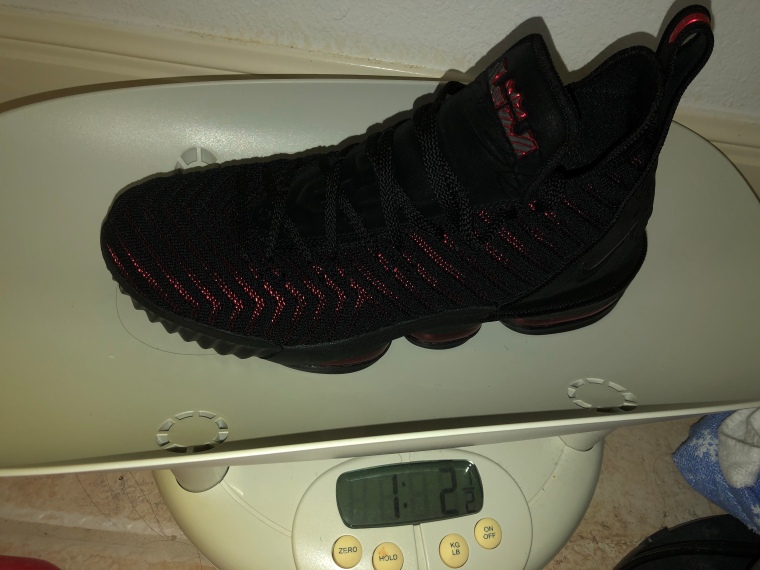
I could care less about the weight and at 18.5 ounces the XVI is a chunker even for a mid (this is not a low). Most mids weigh around 15 ounces while lows average about 13.5-14 ounces. Hit the gym kids if you can’t handle a few extra ounces.
Traction
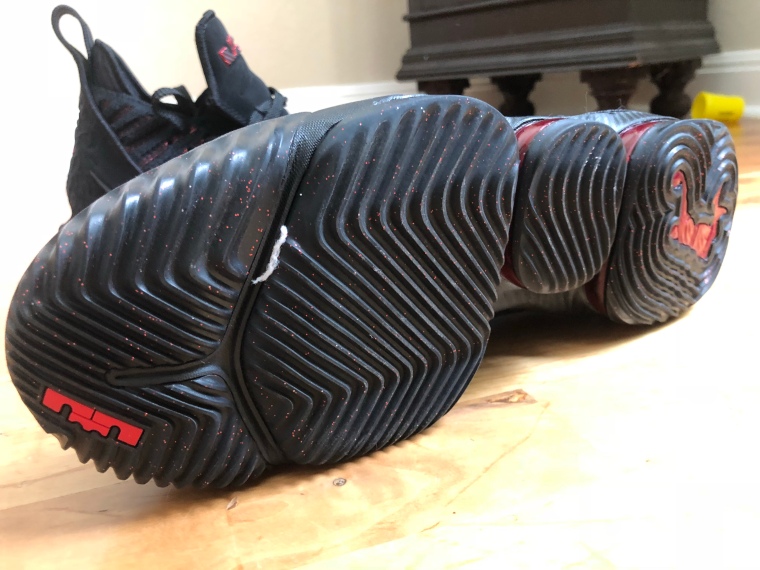
Easily the most improved area from the XV to the XVI. The XVI incorporates a pattern very very similar to the KD 11 which coincidently I reviewed last month. It isn’t quite as thin and pliable like the Soldier XII but it works well, far better than the XV.
Think swolled up Soldier Xii blades.
The rubber used on the XVI is softISH but the blades are thicker than what the Soldier XII used so it doesn’t bite or brush quite as well. You also have to break in the traction a few hours especially in the forefoot to get better bite but it doesn’t take long. Some occasional wiping is needed on dusty floors as well but not often. Easily the most improved part of the shoe from the XV and it’s the best traction on a Lebron sig since the X.
Well done Nike!
Cushioning
These started out a stiffer than the XV but broke in within a few hours to give a very similar albeit still a little stiffer ride to the XV. If you loved the cushioning on the XV you’ll love these.
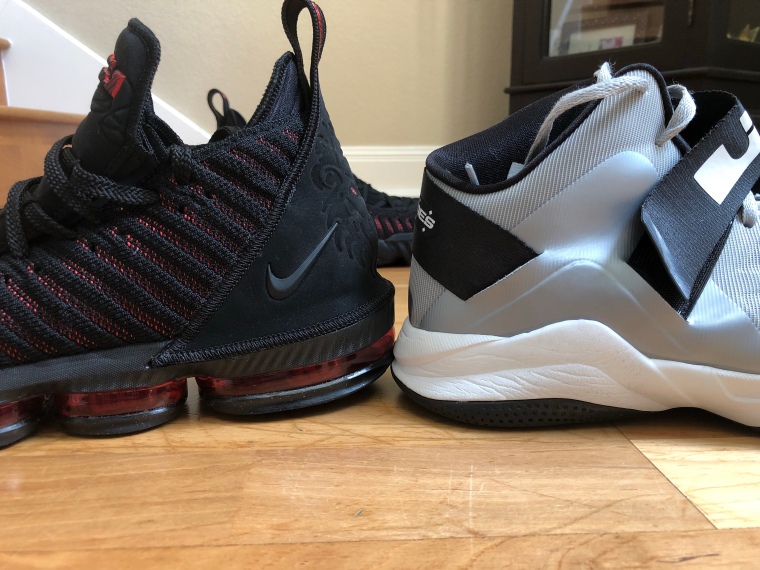
Both the XV and XVI ride fairly high so if you prefer a lower ride don’t buy these. Last year’s XV rode very high so at least these are back down to Lebron X range.
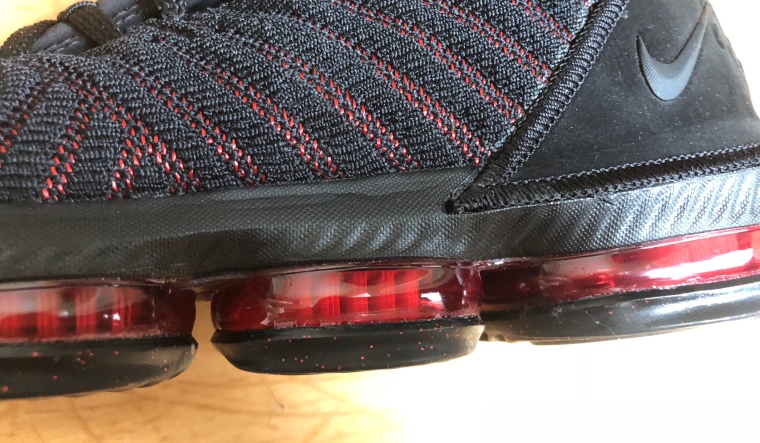
These still sit around 25-26 mm on the forefoot (down from 28-29) and 30-31 in the heel (down from 34-36) which is a good 3-4mm lower than last years (10-15% ish) so if you like Kobe or Curry low to the ground these are not for you. I personally like them lower but it’s all preference and there is no right or wrong answer here. One of the best players I know who is an ultra shifty guard, Lifetime Fitness Ultimate Hoops MVP, semi pro MVP (who literally won the championship and MVP yesterday) and one man wrecking crew loves his XV’s so just comes to show you it ain’t the shoes.
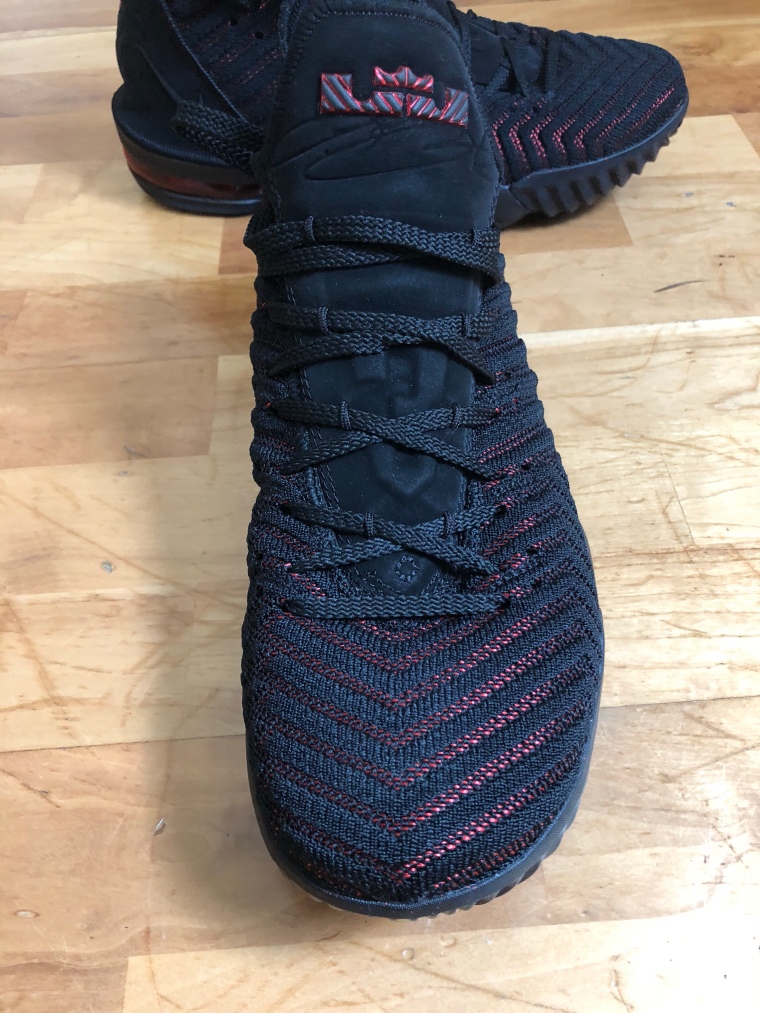
Zoom done right is a perfect balance of impact protection and responsiveness and well, that’s what you get with the XV and now XVI.
Well done Nike!
Fit
I went true to size with the XV and I went tts with the XVI as well (finger width at the toe). I tried on half a size down as well but I just preferred true to size. I’ve said it many times before but you can fit more than one size so experiment with each shoe if you can.
Notice how the “tongue” pulls up for easier access. I’ve never had issues putting one piece shoes on but this should help those who do.
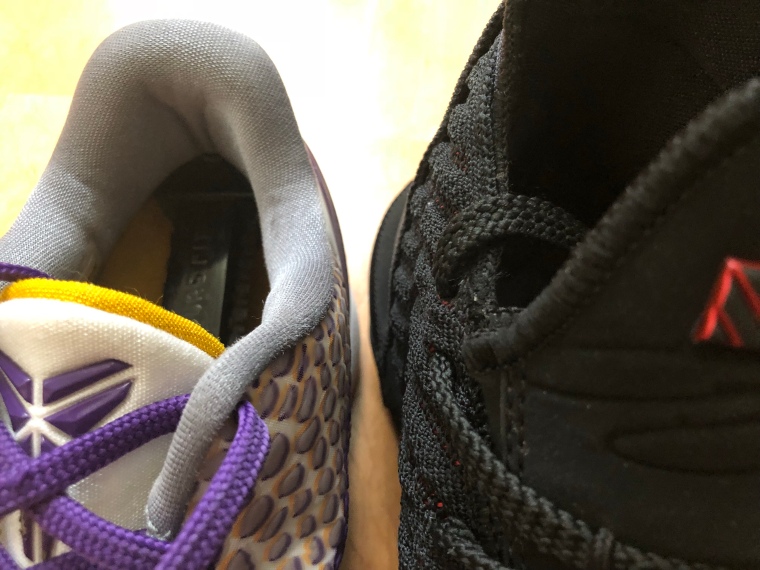
No deadspace at all in the toe box for my fat feet (I think narrow footers can go down half a size) but I did have a little heel slip in my left shoe the first few nights in the XVI. I decided to use the lower eyelets to help and it really worked since it is lower and further back. HOWEVER, it is a pain in the as* to do it because there is glue inside and between the holes (kinky I know) so it took a solid ten minutes to relace just the top eyelets! Maybe arthritis is setting in but it was difficult and made the Harden V1 relacing seem easy. Let’s just hope Nike doesn’t call extra eyelets something like “lace customization technology” #marketing
Here you can see how far back the eyelets are set up a standard Kobe VI
This is how you accelerate break in time
What was really affecting the heel fit was the stiffness of the midsole out of the box. It really wants to stay straight but if you bend them like I do with a lot of shoes, it helps soften up the foam so it conforms to your foot much faster. Once again this is a mid called a low so heel slip really shouldn’t be an issue.
Overall the fit was very good but the heel took some time to break in. After break in, it felt a lot like the Hyperrev 2016 heel where it’s locked in but just feels kind of “floaty”. Very similar design in terms of how the padding is set up around the Achilles.
If you don’t like the feeling, go find a Kobe or another shoe but it just takes some time to get used to it.
Materials
Battleknit Part Deux
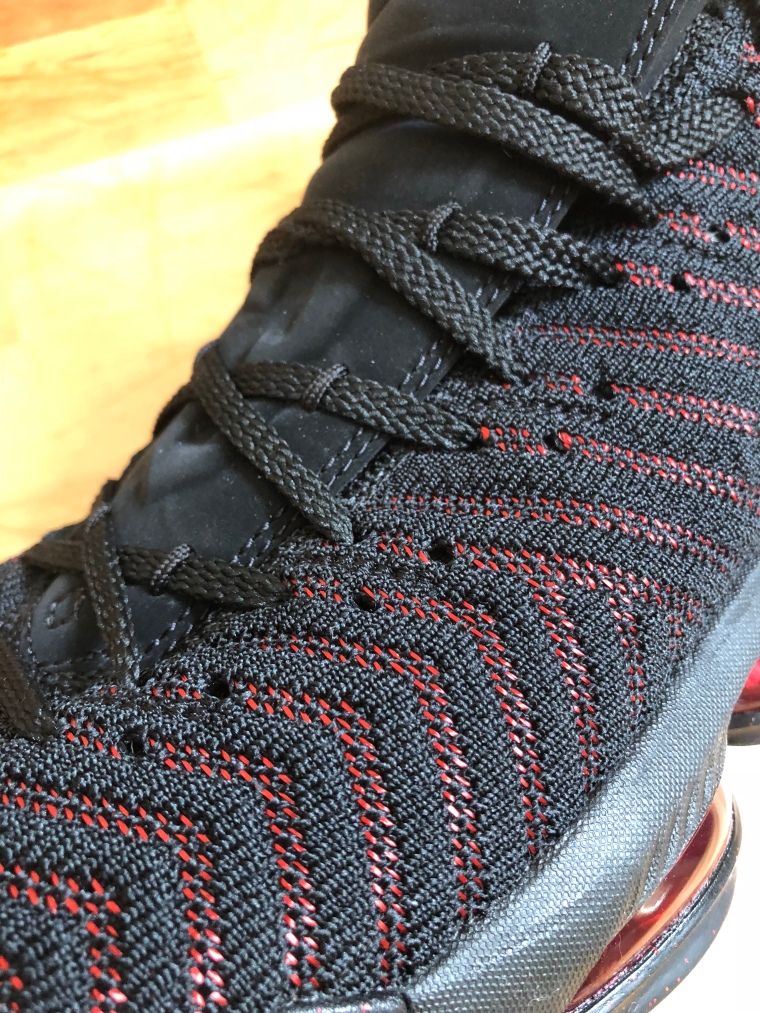
I think shoe companies and so called shoe experts are finally realizing that softer and stretchier doesn’t equal better. Nike’s Lebron 16 was soft with more reinforcement than previous Flyknit applications.
Knit 2.0 feels like it’s backed by a thicker backing but remains flexible but with less stretch. It wouldn’t shock me if it’s the same type of fuse used on the Lebron X but covered in knit. I really like how these were done and feel nice to the touch. Flyknit really allows a lot more texture and color blocking that mesh doesn’t allow. That’s the main benefit of Flyknit…well that and higher profit margins.
Support and Stability

The NBA has gone postionless and so have the shoes.
We now have mids called lows and lows called mids (See Kobe AD Mid). These are lower tops not low tops but are higher than my Soldier VI. The only difference is how the slope of the shoe is more gradual. Whatever
Regardless of nomenclature, support is minimal and comes from the heel counter and fit just like the XV.
Stability drastically improved just by adding a tiny outriggers along the entire lateral side.
I didn’t worry about tippiness at all because those little millimeters added a lot of extra stability. Thanks Nike, no consulting fee this time around.
Containment

Battleknit 2.0 works!
Actually it’s a combination of the large heel counter, thicker Battleknit and the raised portion of the toe. No issues here
Conclusion
Maybe Nike and Lebron visit my site after all haha. I’m not that egotistical nor do I care but everything I didn’t like about the XV (aside from the ride height) was fixed. Better traction, better stability and containment. Hell, next thing you know, a leather hole puncher will be included with each shoe.
So should you buy the XVI now for $185? Ten dollars more than the upcoming AJ 33 🤢 btw. Nope, I walked into Dicks (that just sounds wrong) had a 20% off coupon and got these for $148 plus tax. Like all basketball shoes that aren’t artificially limiting supply , these will be coupon eligible and then eventually discounted and then discounted again as the season progresses. Expected these to get down the $149 mark within a month or two then slap a 20% coupon to get you down to a solid $120. The longer you wait, the more you sav
Although I prefer a lower ride height, this is the best all around Lebron to come out in years. Great traction, cushioning, fit, stability and containment make this a great shoe for most players. Great performer all around with no major weaknesses which sounds a lot like the shoe’s namesake. Finally a Nike sig shoe done right.
First team rating

2018年10月3日星期三

Nike LeBron 16 Performance Review

16? Sixteen! That’s right, Nike took a (not so big) gamble on a high school kid from Akron, Ohio, 16 years ago. And every year since, it seems like Nike has introduced a new technology for LeBron James, from Max Zoom to Hyperposite to Battleknit. Well, the LeBron 16 isn’t new, but it’s a whole lot of goodness. Read on…
Oh my goodness, what is this? A true, gripping, thick traction that needs no wiping, no breaking in, and would work outdoors as well? Who’da thunk it?
Based on the LeBron Soldier 12’s wave-herringbone pattern, the LeBron 16 uses basically straight lines with a slight angle to provide one of the best out-of-the-box grips in recent memory. The pattern is deep and spaced wide enough to push out most of the dirt the shoe encounters (even from casual wear, which these will see a lot of once the Lakers colorway hits). In two weeks of testing I believe I wiped once. Once — not once a day, or once a game — once. After the lateral disaster in the LeBron 15, this was a serious improvement.
Again, as far as outdoors goes, you should actually be good for a few months. The rubber isn’t ’90s Nike hard but it is firmer than most on the shelf today and the pattern is deep. Just remember, once you wear it completely down, you’re skating on Max Air bubbles.
It looks the same, but it doesn’t feel the same. By now you know about the Max Zoom in the LeBron 15 and how it’s bouncy and cushioned at the same time. You probably also know about the compression around the edges and how the midsole felt a little unstable on hard lateral movements. Well, that is no more.
The LeBron 16 has a stiffer overall setup that still provides serious impact protection but feels quicker and smoother from the jump. I’m not sure if it is the actual bags that are tuned tighter or the foam is denser, but instead of sinking into the shoe you get immediate springback into your foot. What good is this?
Well, when jumping on a mattress, or large trampoline, there is a sinking feeling that takes time to get back in the air. Now, on a smaller trampoline, with a higher tuned spring ratio, your body is immediately back into the air on impact. Make sense? Yeah, didn’t think so. Just know this: the LeBron 16 is quicker underfoot than the 15.
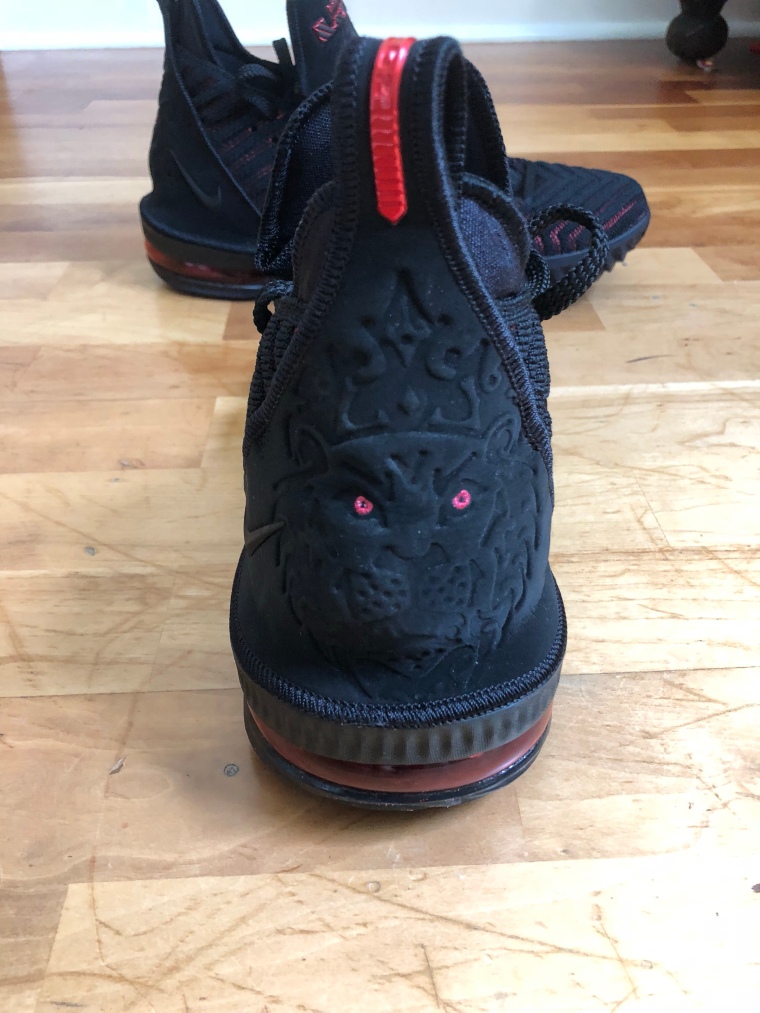
The LeBron 16 uses nubuck and Battleknit 2.0. Sounds like the new evil cousin on Game of Thrones huh? Actually, it looks like a shoe fit for a Lannister, with a lion embossed on the heel and the glowing red eyes. We get a nubuck panel for the details on that area and the tongue. It isn’t the most premium of materials, but it’s nicer than we see on most 2018 basketball shoes. It does start off stiff in the heel, leading to some slight heel slip, but after a couple of day’s worth of games it tightened up.
As for the new version of Battleknit, the worries of last year are gone here as well. While the midsole was a lateral movement away from rolling over, the knit upper wasn’t the strongest option for keeping your foot upright. However, the Battleknit 2.0 on the LeBron 16 is backed by a nylon sleeve for some non-stretch support that still flexes easily on normal forward motions but holds tight on lateral movements. You get the best of both worlds with the upper of the Lebron 16.
Initially, I was not impressed. I felt the heel was slipping a little too much (back to the heel nubuck panel) and the forefoot was a little too roomy, especially over my toes. What a difference a few games makes; after my fourth night wearing them, the upper was flexing and softened up so I could get the shoe pulled tight on my forefoot. The heel, however, needed a little something extra. Enter the re-lacing adventure of the LeBron 16.
For those of you who have this shoe already, you may already know what I’m about to tell you. If you don’t have the shoe, pay close attention. The LeBron 16 has variable-width lacing. There are extra holes, much like the Dame 3 or Harden Vol.2, that allow for a more customized fit. After wearing the shoe for a couple of days, I decided to go with the wider set of laces for a more secure lockdown. Bad choice.
Pulling the laces from the shoe was hard enough, with the Flywire on the tongue being the main issue. Re-lacing back through the knit upper was a task for the jaws of life. The nylon backing is tight but the lace holes don’t run through it, they only run through the knit outer layer. This made getting the aglets back into the shoe a knuckle-scraping, finger-tip-almost-bleeding task that took 15 minutes per shoe. Doing this whole operation cut down on my heel slip issues completely, so I guess it was worth it.
No matter, because after my fourth wear, everything about the shoe just formed around my foot when laced tight and there is now no movement at all. I would say go true to size (I went 10.5 in the LeBron 16 and the AD Exodus) and enjoy your runs.
One thing the LeBron line has never lacked is support — the guy is 6’9″ and 270 pounds. Of course, the designers know he needs a combat boot for the court. That’s what makes Batteknit 2.0 so surprising; knit for this type of shoe seems a little risky, but the tightness of the threads and the no-stretch upper give serious lateral stability and containment. That’s good because the midsole stays in the middle and doesn’t come up the sides of the shoe at all.
Again, the variable lacing helps keep your foot over the footbed on hard slides and the double-layered heel cup and the internal padding lock your rear foot in place — as long as you get he lacing dialed in and give it a little time.
The biggest difference in the LeBron 16 is the midsole. As mentioned above, the Max Zoom combo feels like it is tuned tighter. That leads to stiffer Air bags and less compression. Along the edges, this means that when you’re leaning into a move or cutting harsh the bags won’t collapse and roll — they stay upright and springy.
Then, Nike went and did for us what it did exclusively for LeBron last year: it added small outriggers on each Max Zoom bubble. They aren’t huge outriggers, but they are just enough to keep the shoe upright when playing on your toes. The base of the shoe also feels wider while playing, something that helps on quick jumpers for a stable base.
After 16 models I can’t really say what my favorite LeBron shoe is because that’s a long time with a lot of change. I can say Nike fixed most of the issues found in the 15, and the 15 was an almost-great shoe. In the LeBron 15 we get better traction, a more stable midsole, more responsive cushioning, and a more contained upper that are all built for a King.
If you are an all-around player, or just enjoy playing, the LeBron 16 will suit any play style or move — be it slashing, cutting, shooters, defense, rebounding. The shoe simply handles everything thrown at it and is one of the most fun shoes on the market today…unless you are a Cavaliers fan.

2018年10月2日星期二

nike kyrie 3 vs 2 performance test and comparison

Executive Summary: plays almost exactly the same as the Kyrie 2. Similar firm cushioning and very good traction. Shoe starts stiff but breaks in. No real reason to buy the 3 when the 2 does nearly everything the same or better though.
Kyrie 2 Review
Pros: traction, court feel, fit, support and stability, containment, very durable
Cons: traction pods protrude and cause a little bit of inconsistent traction in the heel, needs periodic wiping on dusty floors on Non pod portions, cushioning needs break in and is very stiff and firm like the KD 11 , materials start stiff but break in, not the best value out there especially now that sale time is upon us.
Sizing: true to size, very wide footers will probably want to go up half a size
Best for: guards looking who value response and quickness; players who liked the Rose 4
Buying Advice: wait for sales, Nike made a lot. $90 is fair, $65 is near the bottom. Or just buy the Kyrie 2
Weight
14.5 oz which is pretty average
Kyrie 2 is the exact same weight
Traction
If there is one thing you can say about the Kyrie line, it’s that it’s traction patterns look aggressive.
The main attraction of the Kyrie 3 traction is the use of traction pods in the forefoot that ride up the sides.
The rubber is softer and raised a millimeter or two from the rest of the shoe.
The concept works and the pods do their job very well. The rest of the shoe is a blade pattern or modified herringbone and feels softer than the Clutchfit Drive herringbone but firmer than the Kyrie 2 rubber. I wish the entire outsole was made of the pods’ rubber or Nike put some of these pods throughout the entire outsole like the AJ XX because on a few occasions I’d spin out at the heel since the forefoot stuck better than the rest of the shoe. This occurred even on pristine floors. Nitpicky I know.
One concern with the traction pods is durability and efficiency once they wear down. I think they will still work fine once they wear evenly with the rest of the outsole but expect more wear in that area due to the softness of the rubber.
Overall traction is very good overall but I feel the Kyrie 2 provided better consistent traction overall especially on dirty floors since it is the same rubber, pattern, and depth throughout the outsole. Neither required too much wiping but the 3 needed a few more wipes per session. Not quite top tier stuff but still good overall.
Cushioning
Here is the tech highlight of the Kyrie 3. The rest of the shoe is Phylon just like last year’s.
If you did not like the cushioning on the Kyrie 2, you will not like the cushioning on the Kyrie 3. Say with me again, if you did not like the cushioning on the Kyrie 2, you will not like the cushioning on the Kyrie 3. One last time..
Cushioning is very firm on the Kyrie 3 just like the 2. It starts off very very stiff but softens a little with break in. I could feel the Zoom a tiny bit just like on the 2. It is serviceable and responsive as Randy noted but I just prefer a little more softness in the forefoot because I have Morton’s neuroma in each foot. The good news is that the neuromas didn’t flare up badly but I could feel some buzzing after an hour just like the 2’s. I prefer a more balanced cushioning feel overall and these are just a little too hard for my tastes. The set up feels almost exactly the same as the Rose 4 except the Rose 4 has a thicker PU insole. Very low to the ground and quick feeling.
*interstingly enough if you check out Fastpass see the Kyrie actually sits at nearly 18 mm which is higher off the ground than the Harden V1 or CLB. Of course that’s not accounting for the insole thickness which probably evens it out. Thanks reader Pflite*
Although this didn’t really affect cushioning much, these two changes make the cushioning on the 3 feel a smidge firmer:
Number 1
The Kyrie 2 featured Poron in the forefoot while this year’s does not. Hard to really tell a difference but to the touch Poron is softer.
Number 2
The Kyrie 2 had an ortholite insole while this year’s doesn’t have the ortholite markings so in guessing it’s not ortholite. Anyways, the name doesn’t matter but the Kyrie 3 insole is very thin and flimsy like a limp noodle (it can barely hold its shape when I took the pic) plus it feels slightly thinner towards the middle than the Kyrie 2 insole. It’s as if someone wore down the insole of the Kyrie 2 and put it into the Kyrie 3. That’s how thin it feels to me. On Adidas Boost models, the thin insole is fine since it has all that Boost below it but with this firm set up, Nike really should have given us a thicker insole.
If you’ve ever played in basketball ball in tennis shoes like the Adidas Barricade or even the Nike Zoom Vapor 9, that’s what the cushioning feels like. Actually the Zoom Vapor 9 has the exact same size Zoom and a similar if not thicker Phylon set up from heel to toe including the foam strobel.
However, the Zoom Vapor feels better because the insole is thicker. If you want to improve the comfort level of the Kyrie 3, get a bigger size and put in a thicker insole to add a couple of millimeters more of cushioning. Keep in mind that it might feel better underfoot but one or two millemeters isn’t going to fix any knee issues you might have.
Fit
I bought my true to size 11 and initially thought I should have gone up half a size. However, after playing in them a few weeks, true to size was the way to go. Even though I’m a wide footer, these stretched out enough for me. If you’re Fred Flintstone, you should at least try half a size up before deciding on the correct width though.
There is no movement in the forefoot, very little deadspace above the foot in the toe box and zero heel slip. Midfoot fit is still tight like the previous models but not deathly like the Kyrie 1.
After a few hours of break in time, you almost forget they are on your feet as the upper softens up. Almost
Even though the Kyrie 3 has a very good fit, the Kyrie 2 has an even better fit due to the strap that helped pull the ankle and heel back further.
Materials
In case you’re part of the Night’s Watch or need to defend Winterfell….
The materials start off stiff but soften up quickly. They don’t feel Flyknit soft or anything but they do soften up enough after a few hours of break in time. The spiked look doesn’t really convey a soft warm comfy feel does it?
The lateral side of the upper is a similar fuse as last year’s model
Not cracker crispy like the Kyrie 1 but not definitely not Snuggles soft.
The medial side and toe box is mesh with a nylon backing and feels a lot softer than the lateral side. The front of the toe box does have a hard rand for durability as well.
I’ve noticed this is a trend these days as shoe companies have added strength and stiffness to the lateral side for containment and support while leaving the medial side soft for flexibility. Hmmm, maybe I did make a difference .(I’m kidding I don’t have that kind of pull)
Of course we can’t forget the featured marketing portion which is the forefoot flex area.
Across the top of the foot, a long stretchy band flexes with your foot for support during quick cuts and sprints.
Nike used a thinner mesh and Flywire to allow extra flexibility at the forefoot. I don’t it feel stretches at all but that thinner mesh allows for a more natural flex area. Plus it’s hard to quantify if it really works since the rest of the upper is so much stiffer than this little area.
If you’re big on materials and have to have that pure Flyknit or Primeknit or mesh feel, you probably will want to steer clear of the Kyrie 3. I think the materials are fine and don’t affect playability but every person has different needs and wants.
Support and Stability
Support is good with the Kyrie 3 thanks to the fit, heel counter and stiffer fuse on the lateral side. Just plain and simple, solid support. As stiff as the upper starts off, it is plenty flexible like the Kyrie 2 and isn’t going to save any ankles
Nike continued with the curved outsole but didn’t choose to market it this time around.
It seems slightly less curved in the forefoot than the Kyrie 2. After not playing in the Kyrie 2 for a year you can feel a difference with the curved outsole but it doesn’t make a difference for me in terms of performance.
Also helping with the stability was the firm, low to the ground cushioning.
Overall just a solid supportive and stable shoe. Same as the Kyrie 2.
Containment
No surprises here as containment was excellent thanks to that stiffer lateral fuse upper as well as the raised midsole. Softer materials might be all the rage but there are benefits to using stiffer and stronger materials like Fuse.
Conclusion
Not the best value out there but a good performer overall. The Kyrie 3 has great traction, a good fit with solid support and stability and very firm cushioning. I had no issues with aches or pains but then again don’t have knee or back issues (knock on wood). The Kyrie 3 just feels like a quick high cut tennis shoe for players that value lateral quickness over everything else.
Cushioning will come down to personal preference and if you didn’t like the 2 cushioning you will not like the 3. I’ll even qualify that statement with this; If you don’t like UA Charged you will not like cushioning on the Kyrie 3. Charged foam is easily thicker bouncier and softer. If you want to improve the comfort of the Kyrie 3, size up and swap out the cheapo insole.
Is the Kyrie 3 an upgrade over the 2? No I don’t feel it did anything better than the Kyrie 2.
Is it worth paying $120? No probably not. There are plenty of shoes out that at the $120-$130 range that do everything just as well or better than the Kyrie 3. Curry 2, 2.5, 3 all come to mind. Plus it’s almost mid season so there are plenty of sales on earlier launches. Do not buy these if you want a softer cushioning set up or if you want a Charmin soft upper material.
I’m guessing Nike made a lot of these to capture the new Kyrie fans post championship. If Kyrie 2 sales are any indication, these should hit $90 under range soon and bottom out around $65. If you want a marginally better performing and cheaper shoe, stick to the Kyrie 2.

2018年10月1日星期一

Nike Kobe AD Exodus 2018 Performance Test

Nope, Nike and Kobe aren’t done. There is another AD in town. So how does the Kobe AD Exodus perform? Let’s go…
What took so long for this review? Didn’t these get purchased on release day? Well, yes, but the traction held me up. On first wearing I was ready to sell the Kobe AD Exodus because I slipped and slid all over the court, falling twice on first steps from a standstill position while trying to drive.
Of course, it was a dirty, bad 24-Hour Fitness court, but when I changed into the Jordan 32 I was good to go. Two days later, same court, same results. Someone was about to get a deal on these. Third wearing, I went to a local college court and played — better floor, better results. I was sticking and moving like Ali so these could work! I went back to the original court for my last wear, and lo and behold, the floor was clean and the results were serious stickiness.
All that said, if you are playing on a fairly clean court, you will be good. I guarantee on dirty courts I wiped these every 4-5 trips down the floor and was still iffy. Once the floor was swept I no issues at all. The soles will suck up every particle of dust in a three mile area, so keep them clean. Outdoors? Next…
Once again, we get a Kobe model with a dispute about the cushioning. We know the heel is Zoom Air, and after seeing the Kobe AD Exodus deconstructed we know it’s a huge heel unit. But what’s in the forefoot? Yeah, it’s foam. It’s basic injected Phylon.
On a budget model (the under-$80 silhouettes) this might not be a bad thing. But on the Kobe AD it’s a little…underwhelming. The caged in forefoot, which uses the same outsole rubber, makes it stiff and dead-feeling. Not as dead as the Kyrie 3 but just a budget foam/forefoot feel. While playing, however, I had no complaints; the forefoot rode low and with very little compression of the midsole so the response was great. Once traction dialed in, change of direction was quick and landing on jumpers or drives was no issue. Not the best, but not a deal-breaker at all.
The heel unit, as mentioned, covers the whole area and is thick (14mm). The only issue I had at all with the heel was coming off screens/curls and planting. I heel plant and turn into my shot to square up and the edges of the Zoom unit would compress under pressure, causing my foot to lean slightly as I planted. I gradually got used to this issue and after a couple of wears it wasn’t an issue. I would gladly trade that feeling for full-length Zoom for impact protection on those back-leaning landings.
I’ve seen better, but the materials work. Yes, we get the felt/suede upper from the Kobe AD Mid, but luckily it isn’t the full upper, so that initial stiffness from the Mid is gone. It still doesn’t breathe, and after every run my shoes were soaked in that area. The tongue area is Nike Pro/Torch material, which is a padded mesh with holes strategically cut into the internal foam for ventilation. Doing this lets the tongue remove lace pressure with the foam but provides ventilation from the holes and mesh; it helps a little.
The forefoot is a combination of two materials: composite mesh and Nike Basketball mesh. The composite is the band you see over the first lace loops, and it provides no-stretch, no-give stability for lateral movements and hard steps. The rest of the toe moving forward is thin mesh, like the PG 1, and it is so light and thin it almost isn’t there. There is a fused area over the big toe — we know why — and that’s it.
Schnug. Not unbearable-in-true-to-size snug, but a really close, tight fit. The materials having little to no give laterally help with that, and honestly, it fits perfect for me. It feels too small until you play and realize the shoe just moves with you with no slow-down or issues.
The one issue I can see some having is around the arch; it’s narrower than any Kobe I can remember in that area and some will want to go a half-size up when buying. I wouldn’t unless you are a wide-footer and can’t stand it. The feeling goes away and the fit will be appreciated later.
The heel is completely locked in with a thick padding around the collar and Achilles. It is still amazing that a shoe with four lace holes can fit like this, but lockdown is complete and total.
As for length, true to size should give you about a quarter-inch of extra space on your big toe, just enough to expand a little on those long days.
For a lowtop that is meant to be light and fast, the Kobe AD Exodus is…light and fast. Support is okay, with a standard heel counter and a raised midsole in the heel and forefoot. There is no midfoot shank, but that isn’t always a deal breaker — the Kobe AD Exodus has a flat sole and serious internal arch structure so midfoot support is good. The forefoot is built without an outrigger, but the sole is rounded off and is slightly wider than the upper so there is no sense of rolling over while playing. Additionally, the composite mesh across the toebox does a fantastic job of holding your foot over the footbed with no give while the regular mesh is soft and feels free.
The rest of the stability and support comes from the simple lacing system and the fit. The Kobe AD Exodus fits almost perfect, as stated above, and when the foot isn’t allowed to slide inside of the shoe it is amazing how support improves.
Transition is another extremely strong point on the Kobe AD Exodus. Often, when a shoe has a flat bottom and different heel/forefoot cushioning, there can be a “slappy” feel when running, like you borrowed your big brother’s shoes or something. This Kobe is smooth in every motion, and that is credited to the fit and the materials being soft in the right places (toebox) and rigid in others (heel counter).
Nope, the Kobe AD Exodus isn’t the best Kobe ever. It isn’t even the best Kobe on shelves right now (still the Protro I). It is, however, a really solid effort from the Swoosh. It does almost everything well on-court (especially clean courts) and is smooth on-foot. Yes, Zoom in the forefoot would have possibly been better (we never know — it may have made the ride stiff and clunky), but the foam does create a quick, low-riding shoe suitable for small guards and wings.
If you are a quick, Kyrie-type, you will love the Kobe AD Exodus. If you are a Kobe-type bigger guard who can get up, you will love this Kobe. If you are a Spurs or Kings fan and still hold grudges about the last 10 years of Kobe’s career, you will probably still like the Kobe AD Exodus on-court. Just sweep it first, trust me.